
Interest Rates Can Reduce Spending. But Can They Fix Today’s Inflation Problem?
Interest Rates Can Reduce Spending. But Can They Fix an Oil Shortage, Housing Shortage or Energy Constraint?
Australia has an inflation problem.
But the more difficult question is what kind of inflation problem Australia currently has.
Normally, higher interest rates work by making borrowing more expensive.
Mortgage repayments rise.
Businesses face higher financing costs.
Households reduce discretionary spending.
Investment slows.
Demand throughout the economy cools.
When demand is running too strongly relative to the economy’s ability to produce goods and services, that process can help bring inflation down.
But what happens when some of the biggest inflation pressures are being caused by things higher interest rates cannot directly produce?
More oil.
More electricity.
More houses.
More construction workers.
More data-centre capacity.
More productive infrastructure.
That is the dilemma increasingly confronting the Reserve Bank of Australia.
RBA Deputy Governor Andrew Hauser recently identified three major upside risks to inflation: the Middle East conflict, the unexpectedly large global AI investment boom and weakness in Australia’s productive capacity. (Reserve Bank of Australia)
Those forces are very different from a household simply spending too much at the shops.
And that makes monetary policy much more complicated.
Australia’s Inflation Rate Is Still Above Target
The latest ABS data show annual CPI inflation eased from 3.8% in June to 3.5% in July.
But underlying inflation remains stubborn.
Trimmed mean inflation was 3.6% in July, unchanged from June. (Australian Bureau of Statistics)
Housing costs increased 5.0% over the year.
Food and non-alcoholic beverages increased 3.2%.
Services inflation was 3.7%.
Non-tradable inflation, which is more closely linked to domestic conditions, remained considerably higher at 4.4%. (Australian Bureau of Statistics)
The RBA’s inflation target is 2% to 3% over time.
So while headline inflation has moderated, underlying price pressure remains above where the central bank wants it.
The current cash-rate target is 4.35%, following three 25-basis-point increases during 2026. The next RBA decision is scheduled for 29 September. (Reserve Bank of Australia)
The RBA Expects Inflation to Stay Elevated for Some Time
The Reserve Bank does not expect a rapid return to comfortable inflation.
Its August forecasts show trimmed mean inflation at approximately 3.3% by the end of 2026 and around 3.0% by mid-2027.
It is not expected to reach about 2.5% until early 2028. (Reserve Bank of Australia)
Headline inflation is expected to return to the 2% to 3% range sooner, around early 2027, but the RBA continues to warn that inflation risks are tilted to the upside. (Reserve Bank of Australia)
That distinction matters.
Headline inflation can be moved sharply by volatile items such as petrol.
Underlying inflation gives policymakers more information about whether broader price pressures are becoming persistent.
And right now, underlying inflation remains elevated.
The Three Inflation Problems the RBA Is Watching
Andrew Hauser’s recent comments highlighted three particularly difficult risks.
First, the Middle East conflict and its effect on global energy and commodity prices.
Second, the global boom in artificial intelligence investment.
Third, weak growth in Australia’s ability to supply goods and services. (Reserve Bank of Australia)
Each can create inflation.
But none can be solved simply by making an Australian homeowner’s mortgage more expensive.
That is the tension at the centre of the current monetary-policy debate.
Problem One: Higher Interest Rates Cannot Produce More Oil
The most obvious example is energy.
The Middle East conflict has disrupted production and shipping and contributed to higher global energy costs.
The RBA’s August Statement says conflict-related input costs are contributing to inflation and warns that a more persistent conflict could keep inflation higher for longer. (Reserve Bank of Australia)
Australian petrol prices have already demonstrated how quickly global energy costs can feed into household expenses.
Automotive fuel prices jumped 7.5% in July after declining for three consecutive months. The ABS attributed the increase partly to higher world oil prices and the partial withdrawal of federal fuel-excise relief. (Australian Bureau of Statistics)
If the RBA increases the cash rate from 4.35% to 4.60%, it does not create another barrel of crude oil.
It does not reopen a shipping route.
It does not increase global refining capacity.
So higher interest rates cannot directly eliminate the source of that price pressure.
Why Would the RBA Raise Rates Anyway?
Because a central bank is not only worried about the original inflation shock.
It is also worried about what happens next.
Suppose fuel prices increase.
A transport company pays more for diesel.
It raises delivery charges.
A retailer pays more for freight.
It raises prices.
Workers see higher living costs and seek higher wages.
Businesses expect inflation to stay high and become more comfortable increasing prices.
At that point, what began as an external energy shock can become embedded in broader domestic inflation.
Higher interest rates attempt to stop that second stage.
They reduce demand and make it harder for businesses to pass every cost increase through to customers.
They can also prevent inflation expectations from becoming permanently elevated.
So monetary policy can still matter enormously.
It simply cannot directly manufacture the supply that is missing.
Problem Two: Australia Is Experiencing an AI Investment Boom
The second pressure is very different.
Artificial intelligence is driving enormous global investment in data centres, computing infrastructure and technology.
And Australia is participating in that boom.
CEDA estimates Australian business investment reached 12.6% of GDP in the June quarter of 2026, its highest share since 2015. (CEDA)
Real business investment increased 10.4% over the year.
Information and telecommunications capital expenditure jumped approximately 91% in 2025-26.
That sector now accounts for 22% of all non-mining capital expenditure. (CEDA)
Automatic data-processing equipment and parts, including servers, GPUs and networking equipment, became Australia’s largest category of imported business equipment during 2025-26, worth approximately $23 billion and up 60% from a year earlier. (CEDA)
This is a major economic investment boom.
Why Can AI Infrastructure Increase Inflation?
Data centres need more than computer chips.
They need land.
Construction workers.
Engineers.
Electricians.
Concrete.
Steel.
Cooling systems.
Electrical infrastructure.
Grid connections.
And enormous amounts of electricity.
If those resources are already scarce, a rapid investment boom can push their prices higher.
RBA Assistant Governor Sarah Hunter has said the Bank is hearing reports of data-centre projects attracting workers at elevated wages because developers want facilities built quickly. ABC reported that the RBA sees this as another source of pressure on an economy already facing capacity constraints. (ABC News)
The RBA’s August outlook also explicitly warns that stronger AI-related investment could create additional bottlenecks in construction and technology supply chains. (Reserve Bank of Australia)
Higher Rates Cannot Build More Electricians Either
Again, monetary policy faces the same limitation.
Raising interest rates cannot instantly train more electricians.
It cannot manufacture transformers.
It cannot immediately expand the electricity grid.
It cannot create more construction labour.
Instead, higher rates reduce demand elsewhere.
If data-centre developers continue competing aggressively for limited workers and materials, the RBA can try to cool activity in other areas of the economy.
That could mean fewer residential developments.
Less business expansion.
Weaker household spending.
Lower investment elsewhere.
Economically, this can bring total demand back toward the economy’s available capacity.
But it creates winners and losers.
The projects driving inflation may continue.
Other households and businesses may absorb more of the slowdown.
Problem Three: Australia’s Supply Capacity Is Weak
This may be the most important long-term issue.
The RBA says growth in Australia’s potential supply remains weak partly because productivity growth is poor.
Its August forecasts assume medium-term trend productivity growth of only around 0.7% annually. (Reserve Bank of Australia)
If the economy can produce goods and services faster, demand can grow without generating as much inflation.
If supply capacity grows slowly, even moderate increases in spending can generate price pressure.
That is why productivity matters so much.
A stronger economy is not simply one where people spend more.
It is one where businesses and workers can produce more with the same resources.
Interest rates can slow demand.
They cannot directly solve productivity weakness.
Housing Is a Perfect Example
Housing demonstrates the policy dilemma particularly clearly.
Annual housing inflation was 5.0% in July.
New dwelling prices increased 5.7% over the year as builders passed through higher materials and labour costs. (Australian Bureau of Statistics)
Australia also faces long-running housing-supply constraints.
Higher rates can reduce housing demand by lowering borrowing capacity.
That can reduce competition among buyers.
But higher interest rates also increase financing costs for developers and builders.
That can make marginal construction projects less viable.
So monetary tightening can reduce demand for housing while potentially weakening future housing supply.
That is one reason housing inflation cannot be solved purely through monetary policy.
Interest Rates Treat Demand, Not the Physical Shortage
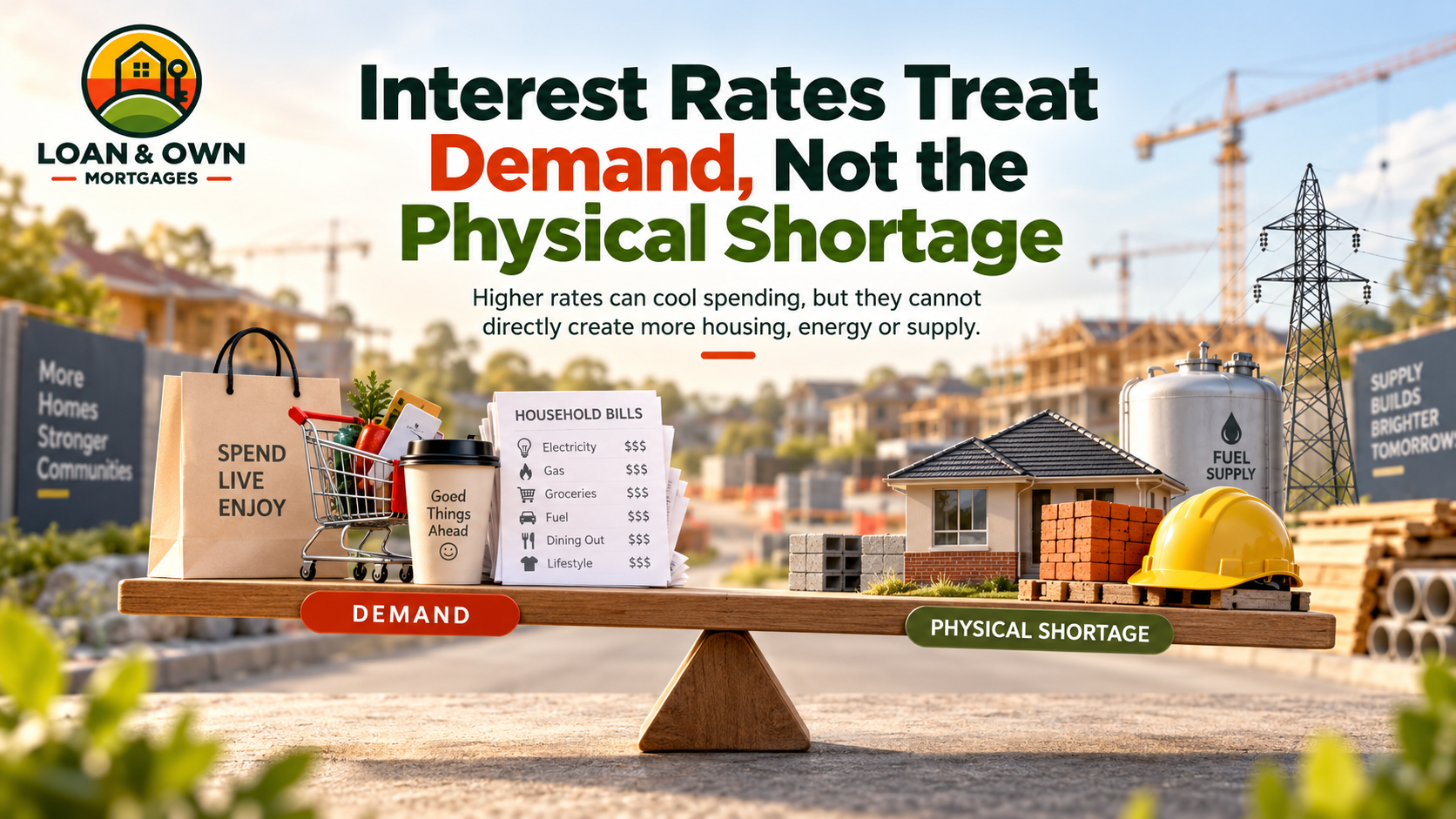
Think about three shortages.
An oil shortage.
A housing shortage.
An electricity-capacity shortage.
Higher mortgage rates do not directly resolve any of them.
What higher rates can do is reduce the amount households and businesses are able or willing to spend.
That lowers overall pressure on scarce resources.
Economists call this bringing aggregate demand back into balance with aggregate supply.
But when the supply side is constrained, achieving that balance can require substantial pain on the demand side.
For mortgage borrowers, that pain can show up directly in monthly repayments.
Why Mortgage Holders Can End Up Carrying Part of the Cost
Australian monetary policy works heavily through households with mortgages.
When the RBA raises the cash rate, variable mortgage rates generally increase.
Borrowers then have less disposable income after making repayments.
They reduce spending.
That is one of the central transmission mechanisms through which monetary policy slows demand.
The difficulty is that today's inflation may partly originate from forces those mortgage holders did not create.
A household in Sydney cannot resolve Middle East oil disruption.
A family in Brisbane cannot build additional electricity infrastructure.
A homeowner in Melbourne cannot fix national productivity growth.
But higher mortgage repayments can still be used to reduce spending elsewhere in the economy.
That is why the current cycle can feel particularly frustrating for borrowers.
The RBA Is Aware of This Limitation
The Reserve Bank does not claim that interest rates can directly solve every inflation source.
Its August outlook explicitly separates domestic capacity pressures from conflict-related cost pressures.
The Bank expects somewhat restrictive financial conditions to reduce domestic demand and capacity pressures while assuming that Middle East-related cost increases eventually unwind. (Reserve Bank of Australia)
That assumption is important.
The RBA’s central forecast assumes oil prices gradually decline.
If they do not, inflation could remain higher for longer.
Similarly, if AI investment creates larger domestic bottlenecks than expected, the inflation outlook could worsen.
That is why the RBA says risks remain skewed to the upside. (Reserve Bank of Australia)
Could Raising Rates Too Much Create Other Problems?
Yes.
Monetary policy involves trade-offs.
If rates remain too high for too long, they can weaken:
household spending,
housing construction,
business investment,
employment growth,
consumer confidence,
and property markets.
The RBA forecasts unemployment gradually rising to around 4.8% by the end of 2028 as economic growth slows. (Reserve Bank of Australia)
That slowing is partly intentional.
The economy needs less demand if inflation is to return to target.
But policymakers have to judge how much slowing is enough.
Too little tightening risks inflation remaining high.
Too much tightening risks unnecessary economic damage.
Why the September RBA Meeting Matters
The RBA’s next interest-rate decision is scheduled for 29 September.
The next monthly CPI release is due on 30 September, the following day. (Reserve Bank of Australia)
That creates an unusual timing problem.
The Board will make its September decision before receiving the next published monthly CPI figure.
However, it will still assess a wide range of information on employment, business activity, household spending, financial conditions, commodity prices and inflation expectations.
Deputy Governor Andrew Hauser has already said the Bank is asking whether the three increases delivered this year have been enough or whether more is needed. (Reserve Bank of Australia)
Borrowers Should Focus on Scenarios, Not Predictions
Nobody can know with certainty what the RBA will decide.
A more useful approach for borrowers is to consider several possible scenarios.
If the cash rate remains at 4.35%, could your household comfortably manage current repayments for another year?
If the cash rate rises another 0.25 percentage points, what would your repayment become?
What if rates stay high longer than expected?
Is your current mortgage rate competitive?
Do you have an offset balance?
Could your lender offer better pricing?
Would refinancing help, or would switching costs outweigh the savings?
Those are questions borrowers can answer today without predicting the RBA.
Supply-Side Inflation Can Keep Rates Higher for Longer
For mortgage holders, the biggest risk may not necessarily be a large sequence of additional rate rises.
It may be persistence.
If oil, construction, electricity and other supply pressures keep inflation above target, the RBA may have less room to lower interest rates.
That could mean borrowers remain exposed to elevated mortgage rates for longer.
A high repayment that lasts six months is very different financially from one that lasts two or three years.
That is why understanding the structure and competitiveness of a home loan matters even when nobody knows exactly what the next RBA decision will be.
A Falling Inflation Rate Does Not Automatically Mean Immediate Rate Cuts
Borrowers should also distinguish between inflation falling and inflation being low enough.
Headline CPI has already declined from 4.6% in March to 3.5% in July. (Australian Bureau of Statistics)
But trimmed mean inflation has actually risen from 3.3% in March to 3.6% in July.
That helps explain why the RBA remains cautious.
The Bank wants evidence that inflation is returning sustainably to target, not simply that volatile headline inflation has temporarily fallen.
The Bigger Lesson: Interest Rates Are a Powerful Tool, but Not a Complete Solution
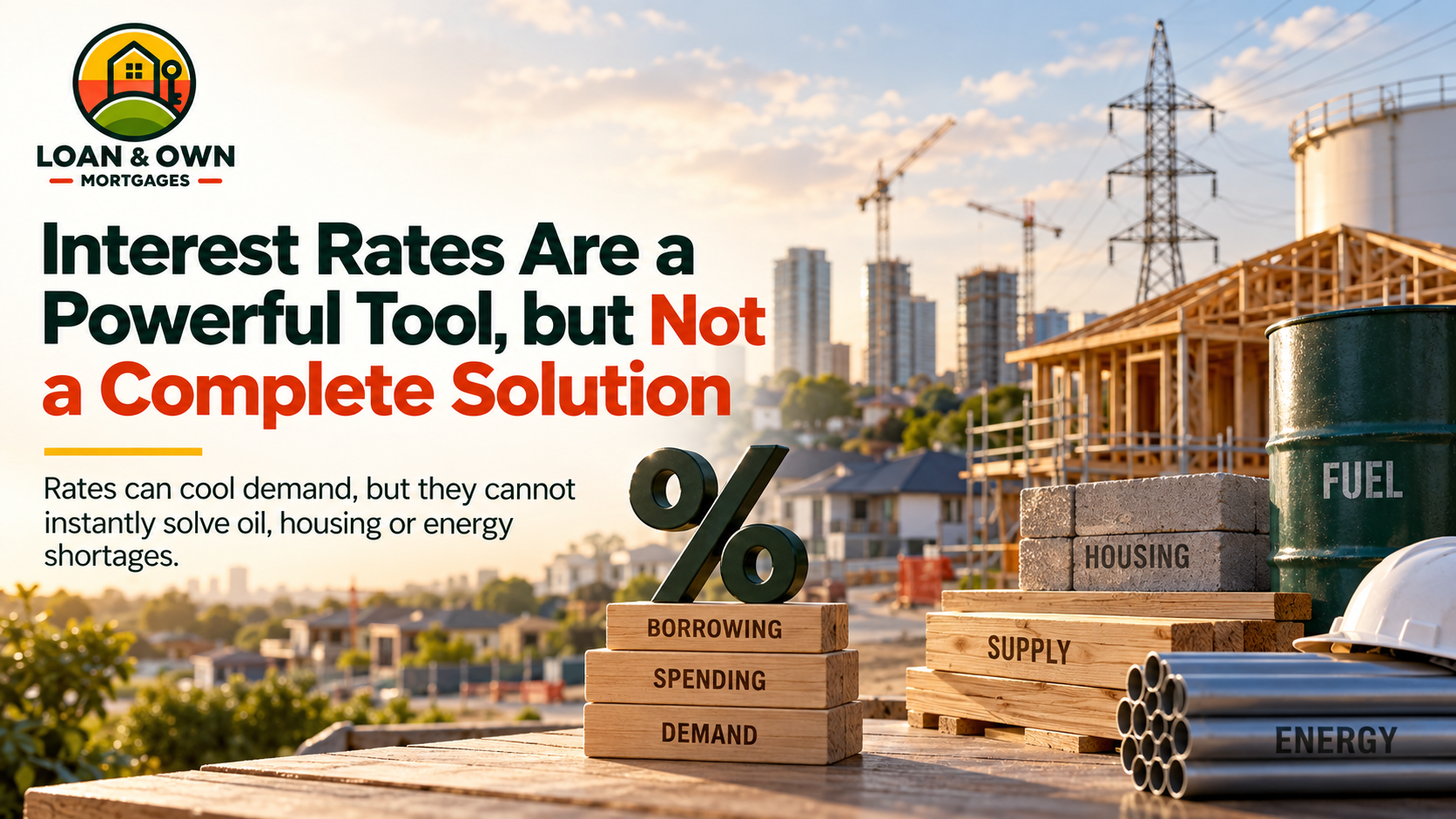
Interest rates are effective at slowing spending.
They can reduce demand.
They can cool labour markets.
They can make businesses more cautious about increasing prices.
They can stop temporary inflation shocks from spreading throughout the economy.
But they cannot directly create the supply the economy lacks.
They cannot pump more oil.
They cannot instantly expand electricity generation.
They cannot build thousands of houses overnight.
They cannot immediately raise productivity.
And they cannot rapidly train the workers needed for data centres, housing construction and infrastructure.
That is why Australia's current inflation challenge is unusually difficult.
The RBA is trying to control the inflationary consequences of supply problems with a tool that primarily affects demand.
For borrowers, the consequence may be an interest-rate environment that remains uncomfortable even though some of the original inflation pressures lie far beyond household spending.
What Does This Mean for Your Mortgage?
The practical takeaway is not that borrowers should try to become macroeconomic forecasters.
It is that relying entirely on future rate cuts may be risky.
A homeowner can instead focus on the parts of the mortgage they can control.
Check the rate being charged.
Compare it with available lender pricing.
Review the loan structure.
Understand how much equity is available.
Check whether an offset is being used effectively.
Stress-test another 0.25% or 0.50% increase.
And understand whether refinancing or negotiating with the existing lender could improve the position.
The inflation problem may be complicated.
Your mortgage strategy does not have to be.
Is Your Home Loan Prepared for a Higher-for-Longer Environment?
At Loan & Own Mortgages, we help Australian homeowners, buyers, investors and self-employed borrowers understand how changing economic conditions could affect their home loan.
Whether the RBA raises rates again or simply keeps them elevated for longer, it can be useful to understand whether your current mortgage remains competitive and appropriately structured.
You cannot control oil markets, AI investment or Australia's supply constraints.
But you can understand your mortgage and the options available to you.
Speak with Loan & Own Mortgages to review your home loan before the next RBA decision.
Data sources
ABC News, 15 September 2026: Analysis identified Middle East disruption, AI-related investment and weak domestic supply capacity as major current inflation pressures and questioned how effectively higher interest rates can address supply-driven inflation. (ABC News)
Reserve Bank of Australia, August 2026 Statement on Monetary Policy: The RBA expects underlying inflation to remain above the target band for some time, with risks from Middle East cost pressures, AI-related investment and persistent domestic capacity constraints. (Reserve Bank of Australia)
Australian Bureau of Statistics, July 2026 CPI: Annual CPI inflation was 3.5%, trimmed mean inflation was 3.6%, housing inflation was 5.0%, and automotive fuel prices increased 7.5% during July. (Australian Bureau of Statistics)
Reserve Bank of Australia, Andrew Hauser interview, 8 September 2026: The Deputy Governor identified the Middle East conflict, the global AI boom and weakness in Australian supply capacity as three upside risks to inflation. (Reserve Bank of Australia)
CEDA, September 2026: Australian business investment reached 12.6% of GDP in the June quarter, while real capital expenditure in information and telecommunications increased approximately 91% over the year as data-centre and AI investment accelerated. (CEDA)
Reserve Bank of Australia: The current cash-rate target is 4.35%, with the next monetary-policy decision scheduled for 29 September 2026. (Reserve Bank of Australia)
This article contains general information only and does not constitute personal financial, credit, investment, tax or legal advice. Mortgage rates, lender policies, refinancing eligibility and economic conditions can change, and individual circumstances should be considered before making lending decisions.
