
Oil Breaks US$100: Could Higher Fuel Costs Keep Australian Mortgage Rates Higher for Longer?
Oil Has Broken US$100. Could Your Mortgage Be the Next Thing Affected?
A conflict thousands of kilometres from Australia could end up affecting household budgets here in a surprisingly direct way.
Global oil prices have surged as escalating Middle East tensions disrupt energy markets and raise concerns about future supply. Brent crude was trading at US$99.17 a barrel on the afternoon of 9 September, according to ABC's market coverage. By 10 September, Reuters reported Brent holding at approximately US$101.10 a barrel, after pushing through the psychologically important US$100 level.
For Australian mortgage holders, this may initially look like an energy-market story rather than a home-loan story.
But oil affects petrol. Petrol affects household budgets and business costs. Those costs affect inflation. And inflation plays a major role in determining how long the Reserve Bank of Australia keeps interest rates elevated.
That is why this latest oil surge deserves attention from borrowers.
The Numbers to Watch
Indicator | Latest position |
|---|---|
Brent crude, 9 September ABC snapshot | US$99.17/barrel |
Brent crude, 10 September | ~US$101.10/barrel |
Brent rise since early August | Nearly 30% |
Australian annual CPI, July | 3.5% |
Trimmed mean inflation | 3.6% |
Australian fuel-price increase in July | +7.5% month-on-month |
RBA cash rate | 4.35% |
Next RBA decision | 29 September 2026 |
Reuters says Brent has risen nearly 30% since early August, with attacks on shipping and continuing disruption in the Persian Gulf keeping supply concerns elevated.
The timing is particularly important because the RBA is already dealing with inflation above its preferred range.
The RBA Was Worried About the Middle East Before Oil Broke US$100
During an ABC 7.30 interview on 8 September, RBA Deputy Governor Andrew Hauser specifically identified three upside risks to Australian inflation.
They were the continuing Middle East crisis, the unexpectedly large global AI investment boom, and weak supply capacity within the Australian economy.
Hauser's message was important.
The Australian economy remains relatively resilient on several measures, but the RBA still has what he described as one major problem: inflation remains too high.
The question facing the Board is therefore whether the rate increases already delivered are sufficient or whether more tightening may eventually be required.
Since those comments were made, oil has moved above US$100.
That does not automatically mean another RBA hike.
But one of the inflation risks the Deputy Governor explicitly identified has clearly intensified.
Why Oil Matters to Australian Inflation
Australia may be geographically distant from the Middle East, but domestic fuel prices remain heavily connected to global energy markets.
The RBA estimates that global crude oil accounts for around 40% of the final Australian retail fuel price.
Changes in global oil prices can flow into Australian petrol and diesel prices relatively quickly, typically with a lag of up to one or two weeks.
The Australian dollar also matters.
Oil is globally priced in US dollars, so movements in the AUD/USD exchange rate can either soften or amplify changes in international oil prices for Australian consumers.
Refining margins, shipping costs, taxes and fuel-excise arrangements also affect the final pump price.
That means a 20% increase in Brent does not necessarily produce an identical 20% rise in Australian petrol.
But sustained global oil increases generally create upward pressure.
Australians Were Already Paying More for Fuel Before This Latest Surge
The latest ABS inflation figures show energy pressure was already returning.
Australian automotive fuel prices jumped 7.5% in July, following three consecutive months of declines.
The ABS attributed the increase to higher global oil prices and the partial unwinding of federal fuel-excise relief measures.
Transport inflation increased to 1.6% annually in July, compared with just 0.1% in June.
And importantly, those figures predate Brent's latest move through US$100.
So the next stage of the oil-price increase has not yet been fully reflected in Australia's official inflation numbers.
A 10% Fuel Increase Can Have a Noticeable CPI Impact
The RBA has previously quantified the direct inflation impact of higher petrol and diesel prices.
Fuel represents approximately 3.3% of Australia's CPI basket.
According to the RBA, a 10% increase in domestic fuel prices could add a little more than 0.3 percentage points to headline inflation over one to two quarters, before considering broader indirect effects.
That is a useful rule of thumb.
It does not mean the latest increase in Brent will automatically add 0.3 percentage points to inflation.
The change in retail fuel prices is what matters, not crude oil alone.
But it demonstrates why the RBA pays close attention when oil prices rise sharply.
The Indirect Inflation Effect Could Matter Even More
The petrol station is only the first place households notice higher oil prices.
Fuel is embedded throughout the Australian economy.
Transport companies use diesel.
Farmers use fuel to operate machinery.
Tradies drive between jobs.
Construction materials need to be delivered.
Supermarkets rely on extensive logistics networks.
Airlines consume aviation fuel.
Manufacturers depend on transport and petroleum-based inputs.
The RBA estimates fuel contributes indirectly to around 2% to 2.5% of the domestic costs involved in producing and distributing other goods and services included in the CPI.
That means higher oil prices can gradually move beyond petrol and into the cost of groceries, deliveries, construction, services and other products.
Businesses then face a choice.
They can absorb higher costs and accept lower margins, find productivity savings, or pass some of the cost increase to customers.
If enough firms choose the third option, inflation becomes broader.
Why Has Oil Moved Above US$100?
The current surge is closely linked to worsening geopolitical and supply risks.
Reuters reports that attacks on shipping and escalating conflict involving Iran and the United States have raised fears of prolonged disruption to Persian Gulf oil flows.
The Strait of Hormuz is particularly important because it historically handled close to 20% of global oil and gas shipments. Current flows remain substantially disrupted.
Iran-backed Houthi attacks have also increased concerns around Saudi Arabian energy infrastructure and alternative shipping routes through the Red Sea.
Markets therefore are not simply pricing the oil that has already been lost.
They are also pricing the risk that disruption becomes worse.
That geopolitical risk premium can keep prices elevated even when some supply continues reaching international buyers.
US$100 Is a Headline. Duration Is What Really Matters.
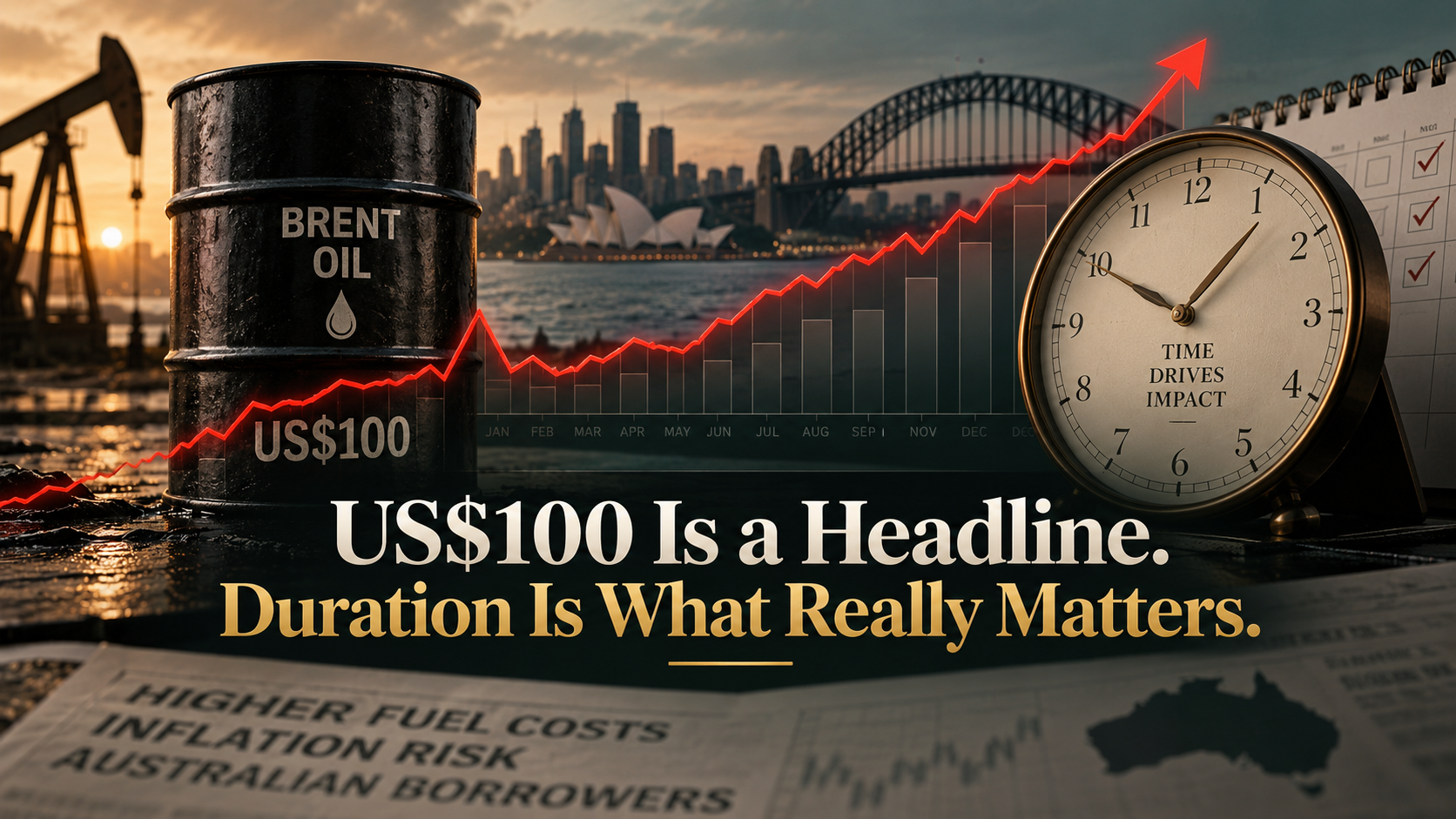
For Australian borrowers, the US$100 threshold itself is less important than what happens next.
If Brent briefly trades above US$100 and then falls rapidly back toward US$80, the inflationary consequences may prove temporary.
But if oil remains around US$100 or climbs further for several months, the situation changes.
Businesses have more time to pass higher transport and energy costs through to customers.
Household petrol budgets remain elevated.
Inflation expectations may become harder to contain.
And the RBA may become more cautious about reducing interest rates.
This is why central banks distinguish between temporary price shocks and persistent inflation.
Australia's Inflation Problem Has Not Disappeared
Australia's Consumer Price Index increased 3.5% over the 12 months to July 2026.
Trimmed mean inflation was 3.6%.
Both remain above the RBA's 2% to 3% inflation target range.
The RBA currently has the cash-rate target at 4.35%, effective from 12 August, with its next decision scheduled for 29 September 2026.
So the central bank is confronting the oil shock from a position where inflation is already elevated.
That makes the situation different from an oil-price increase occurring when inflation is safely below target.
Could US$100 Oil Cause Another RBA Rate Rise?
Potentially, but not by itself.
The RBA will consider the oil shock alongside employment, wages, economic growth, household spending, business conditions, housing activity and broader measures of underlying inflation.
Hauser stressed that Australia's outlook remains balanced, noting falling house prices and weak consumer confidence alongside stronger-than-expected inflation and growth data.
So the RBA is unlikely to respond mechanically to a single commodity price.
The key question will be whether higher energy costs threaten to produce persistent inflation.
If oil pushes headline inflation higher for a short period but underlying inflation continues easing, policymakers may look through part of the move.
If businesses begin passing higher transport and input costs into prices more broadly, however, the RBA could become more concerned.
What Does This Have to Do With Your Mortgage?
The relationship is indirect, but important.
For a variable-rate borrower, the chain could look like this:
Higher oil prices → higher petrol and operating costs → stronger inflation pressure → RBA keeps rates restrictive for longer → mortgage rates stay elevated for longer.
That final step is what borrowers should focus on.
The biggest mortgage implication may not necessarily be another immediate rate increase.
It could simply be that expected rate relief gets pushed further into the future.
For households already paying much higher mortgage rates than they did several years ago, that delay matters.
Oil Can Also Influence Fixed Mortgage Rates
Variable mortgages are not the only lending products exposed to global conditions.
Higher oil prices can also influence inflation expectations in bond markets.
If investors expect inflation to remain stronger, government bond yields and other market interest rates can rise.
Banks use wholesale markets, deposits and other sources to fund lending.
Fixed mortgage rates are therefore influenced by broader market funding and swap rates rather than only the RBA's overnight cash rate.
This means financial markets can reprice fixed home loans even before the RBA makes another decision.
Borrowers considering fixing part or all of their mortgage should therefore understand that rate markets move every day, not simply eight times a year when the RBA announces monetary policy.
There Is Also a Direct Household-Budget Effect
Oil does not need to change the RBA cash rate to affect mortgage stress.
Imagine a household whose mortgage repayment stays exactly the same.
If that household suddenly spends an additional $40 or $60 each week on petrol, groceries and other transport-sensitive expenses, less income remains available after essential bills.
The mortgage itself has not changed.
But mortgage affordability has.
This distinction is important.
Household financial pressure is determined not just by the interest rate on the home loan, but by everything competing for the same pay packet.
Higher oil prices can therefore worsen household cash flow even without an RBA move.
Regional and Commuter Households Could Feel It More
The financial impact will not be identical across Australia.
A household living near public transport in an inner-city location may use relatively little petrol.
A family with two vehicles and long daily commutes can be far more exposed.
Regional Australians may also have fewer alternatives to driving.
Tradespeople and self-employed borrowers who operate vehicles for work can face both household and business fuel increases simultaneously.
Those differences matter when assessing financial resilience.
Business Borrowers Face Another Layer of Risk
For Australian businesses, higher energy prices can affect both expenses and financing conditions.
A logistics company may experience higher diesel costs.
A construction company may pay more to operate machinery and transport materials.
A café may receive more expensive deliveries.
A manufacturer may see freight and input costs rise.
If margins become tighter, debt repayments consume a larger proportion of business cash flow.
And if inflation also keeps interest rates elevated, businesses can face higher operating costs and expensive finance at the same time.
For business owners considering refinancing, equipment finance, commercial property lending or working-capital facilities, understanding both sides of that equation is increasingly important.
Construction Costs Could Also Feel the Impact
Australia is already dealing with elevated residential building costs.
Higher oil can add pressure through transport, machinery operation, imported materials and logistics.
For someone building a home, that matters because construction affordability depends on more than the mortgage rate.
A project can become more expensive if labour, materials and transport costs rise.
That makes contingency planning important for borrowers considering construction finance.
What Should Mortgage Holders Be Watching?
Rather than trying to predict the next oil-price move, borrowers can monitor the indicators that show whether the shock is actually reaching Australia.
The most important signals are Australian petrol and diesel prices, upcoming CPI releases, underlying inflation, global bond yields and the language used by the RBA around its 29 September meeting.
The next monthly CPI release is scheduled for 30 September, one day after the RBA's September decision.
That unusual timing means the September Board meeting will occur before policymakers receive the August CPI publication.
However, the RBA will still have access to a broad range of other economic and market data.
Borrowers Cannot Control Oil, But They Can Control Their Mortgage Strategy
Global oil prices are unpredictable.
Middle East developments are unpredictable.
The RBA's next decision is uncertain.
But homeowners can still review their own financial position.
A useful review might examine the mortgage rate currently being charged, whether the loan remains competitive, the size of the household cash buffer, how effectively an offset account is being used, whether unnecessary fees are being paid and whether refinancing alternatives are available.
The objective is not to refinance simply because oil reached US$100.
It is to ensure the mortgage remains suitable if rates stay high for longer than previously hoped.
Higher for Longer May Be the Bigger Risk
For many homeowners, the biggest financial risk is not necessarily another dramatic interest-rate surge.
It may be persistence.
A household can absorb a high repayment for six months very differently from absorbing it for another two years.
Today's oil shock therefore matters because it could make inflation slower to return to target.
If that happens, the RBA may have less room to provide mortgage-rate relief.
That is why borrowers should increasingly think in terms of financial resilience rather than trying to forecast the precise date of the next rate cut.
The Bigger Lesson: Global Events Can Reach Your Mortgage Faster Than You Think

At first glance, there is a huge distance between a tanker in the Persian Gulf and a mortgage on a home in Sydney, Brisbane, Melbourne or Adelaide.
Economically, the distance is much shorter.
Oil affects fuel.
Fuel affects transport and production.
Those costs influence consumer prices.
Consumer prices influence inflation.
Inflation influences monetary policy.
And monetary policy heavily influences mortgage rates.
Brent crude moving above US$100 per barrel therefore deserves more attention from Australian borrowers than the typical commodity-market headline.
It does not guarantee higher mortgage rates.
But it increases one of the inflation risks the RBA was already worried about.
And in today's environment, even delaying future rate relief could have a meaningful impact on household finances.
Is Your Mortgage Prepared if Rates Stay Higher for Longer?
At Loan & Own Mortgages, we help Australian homeowners, buyers, investors and self-employed borrowers understand their lending position as economic conditions change.
You cannot control global energy markets.
But you can understand the rate you are paying, compare available options, review your loan structure and know what different interest-rate scenarios could mean for your household.
Speak with Loan & Own Mortgages to review your home loan and prepare for what comes next.
Data sources
ABC News, 9 September 2026: Brent crude futures traded around US$99.17 a barrel during Australian afternoon trading, after reaching a six-week high as Middle East tensions escalated.
Reuters, 10 September 2026: Brent crude held above US$100 at approximately US$101.10 as attacks on shipping increased concerns about prolonged Persian Gulf supply disruption.
Reserve Bank of Australia, Andrew Hauser interview, 8 September 2026: Deputy Governor Andrew Hauser identified the Middle East crisis, the global AI investment boom and weak Australian supply capacity as three upside risks to inflation.
Australian Bureau of Statistics, CPI July 2026: Annual inflation was 3.5%, trimmed mean inflation was 3.6%, and Australian automotive fuel prices increased 7.5% during July.
Reserve Bank of Australia, May 2026 Statement on Monetary Policy: Fuel accounts for approximately 3.3% of Australia's CPI basket, global crude represents around 40% of retail fuel prices, and a 10% domestic fuel-price increase could directly add just over 0.3 percentage points to headline inflation over one to two quarters.
Reserve Bank of Australia: The current cash-rate target is 4.35%, with the next monetary-policy decision scheduled for 29 September 2026.
This article provides general information only and does not constitute personal financial, credit, investment, tax or legal advice. Oil prices, inflation expectations and interest rates can change rapidly. Loan rates, eligibility and refinancing suitability depend on individual circumstances and lender assessment.
