
Fewer Property Sales Just Created a 24% Hole in NSW Stamp Duty Revenue. Here’s Why the Housing Slowdown Matters Beyond Home Prices.
Fewer Property Sales Just Created a 24% Hole in NSW Stamp Duty Revenue. Here’s Why the Housing Slowdown Matters Beyond Home Prices.
When Australia's property market slows, most attention goes to homeowners.
How much have prices fallen?
Are buyers getting better deals?
Will higher interest rates push values lower?
Can borrowers still refinance?
But the housing market has another important economic role that receives much less attention.
It generates billions of dollars in tax revenue for state governments.
And in New South Wales, the current property downturn is now showing up clearly in the state's finances.
Reuters reported on 16 September that NSW residential property stamp-duty revenue fell 24% year-on-year in August, reaching its lowest monthly level since the pandemic.
Residential property transactions were approximately 18% lower than a year earlier. NSW Treasury now expects around A$5.3 billion less transfer-duty revenue over the next four years, including an estimated A$2 billion downgrade in the current financial year. Reuters
Those figures show why a property downturn is much bigger than falling house prices.
When fewer homes change hands, governments also collect less revenue from those transactions.
And that can affect the financial resources available for infrastructure, transport, housing programs and other public services.
The Key Numbers Behind the NSW Property Slowdown
Indicator | Latest position |
|---|---|
NSW residential stamp-duty revenue, August | -24% year-on-year |
Residential property transactions | About -18% year-on-year |
NSW transfer-duty downgrade over four years | About A$5.3 billion |
Estimated downgrade this financial year | About A$2 billion |
Sydney home values in August | -1.4% |
Sydney decline from February peak | -7.1% |
National home values from March peak | -3.6% |
National annual property sales | -2.7% |
Capital-city annual sales | -5.2% |
NSW investor loan commitments, June quarter | -15.5% |
Reuters says the August stamp-duty intake was the weakest monthly result since the COVID-era disruption. Reuters
At the same time, Cotality reported Sydney home values fell another 1.4% in August and were 7.1% below their February peak. National values were 3.6% below the March peak. cotality.com
So NSW is facing both sides of the property slowdown:
lower property values and fewer transactions.
Both matter for stamp-duty revenue.
What Exactly Is Stamp Duty?
Stamp duty is now formally called transfer duty in NSW.
It is a state tax generally paid by the buyer when ownership of property is transferred.
Revenue NSW says transfer duty commonly applies when purchasing:
a home,
investment property,
vacant land,
commercial property,
or another interest in property. Revenue NSW
For residential buyers, the amount generally depends on the property's dutiable value.
That is usually the higher of the purchase price or market value.
NSW uses a sliding scale rather than one flat percentage.
For the 2026–27 financial year, general transfer-duty rates increase progressively with property value, with a higher premium rate applying to residential property above A$3.87 million. Revenue NSW
This structure helps explain why Sydney is so important to NSW government revenue.
Sydney has some of Australia's highest property values.
When an expensive Sydney home changes hands, the associated transfer-duty payment can be substantial.
But if that sale never occurs, the government receives no transfer duty from that transaction.
Why Transaction Volumes Matter So Much
Property-tax revenue depends on more than house prices.
Turnover is critical.
Imagine property prices remain relatively high, but buyers and sellers stop transacting.
Stamp-duty revenue still falls.
That is essentially what the latest NSW figures demonstrate.
Residential transactions were down around 18%, while residential stamp-duty revenue fell 24%. Reuters
The revenue decline was larger than the fall in transaction numbers.
There can be several reasons for that.
Fewer expensive properties may be selling.
Higher-value property segments may be experiencing larger price declines.
Buyers may be shifting toward cheaper properties.
And overall market turnover may be weakening.
The exact composition matters because stamp duty rises with property value.
Sydney Is Leading Australia's Housing Downturn
The weakness in NSW tax receipts is closely connected to what is happening in Sydney.
Cotality says Sydney home values were down 7.1% from their February peak by August, making Sydney the weakest major housing market in the current correction. cotality.com
The downturn is especially severe at the premium end.
Cotality's September Housing Chart Pack shows upper-quartile Sydney house values are now 10.7% below their cyclical peak. cotality.com
Those higher-priced properties are particularly important for stamp-duty revenue because each transaction typically produces a larger tax payment.
If fewer premium homes sell, the revenue effect can therefore be disproportionate.
The Property Market Is Also Becoming Less Liquid
Another way to understand the current slowdown is through selling conditions.
Cotality reports:
national property sales fell 2.7% over the year to August,
capital-city sales declined 5.2%,
the median time required to sell a property increased from 28 days to 39 days,
vendor discounting widened to 4.2%,
and listings increased 18.1% year-on-year. cotality.com
Auction conditions have also weakened.
The four-week average capital-city clearance rate was only 49.5% at the end of August and had remained below 50% since early June. cotality.com
All of this points to slower property turnover.
For households, that can mean longer selling periods and greater negotiating pressure.
For the NSW government, it can mean fewer taxable property transfers.
Lending Activity Has Also Slowed
The slowdown is visible in mortgage lending.
ABS data shows the number of new dwelling loan commitments nationally fell 5.4% in the June quarter.
Investor loans fell much more sharply, declining 8.6%. Australian Bureau of Statistics
New South Wales recorded the largest state-level fall in investor loan commitments:
15.5% during the quarter. Australian Bureau of Statistics
That matters because fewer financed purchases today can translate into fewer settled property transactions later.
A weaker mortgage market and weaker stamp-duty revenue are therefore connected.
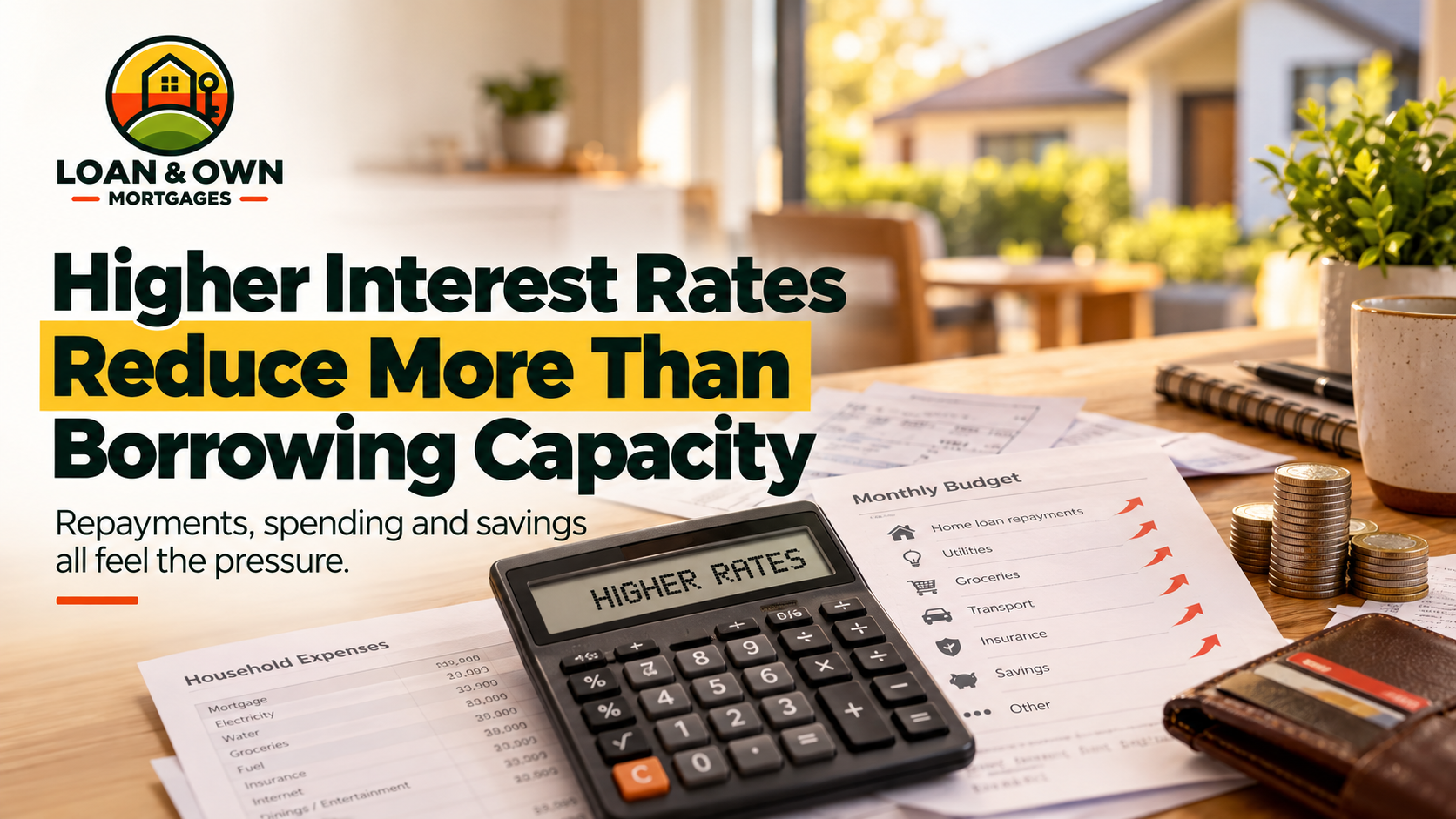
Higher Interest Rates Reduce More Than Borrowing Capacity
The RBA cash rate is currently 4.35%.
Higher mortgage rates have already reduced borrowing capacity and increased monthly repayments.
That affects buyer demand.
A household that might previously have qualified for a A$1.2 million mortgage could potentially qualify for materially less under higher interest rates and lender serviceability requirements.
That can result in:
buyers reducing their property budgets,
buyers delaying purchases,
investors stepping away from the market,
owners choosing not to upgrade,
and fewer transactions overall.
The effect therefore travels beyond the individual mortgage borrower.
Lower turnover eventually affects:
real-estate agents,
conveyancers,
mortgage brokers,
removal companies,
renovation businesses,
furniture retailers,
and state-tax revenue.
Housing is connected to a large economic ecosystem.
Why NSW Is Particularly Exposed to Property Turnover
Stamp duty has historically been a significant revenue source for NSW.
The state's 2025–26 Budget forecast transfer-duty revenue of approximately A$13.36 billion for that financial year and A$14.03 billion in 2026–27. NSW Government
Those forecasts predate the latest downturn and subsequent revenue downgrade.
The comparison illustrates how meaningful property transactions are to the state budget.
When revenue running into the billions depends partly on homes continuing to change hands, a sharp housing-market slowdown can materially alter the fiscal outlook.
This Has Happened Before
Stamp-duty revenue is naturally volatile because property markets move in cycles.
NSW Treasury has repeatedly revised transfer-duty forecasts as transaction volumes and property prices changed.
For example, the 2024–25 Half-Yearly Review downgraded transfer-duty revenue by A$391.7 million for that year because residential transaction volumes had been weaker than expected. NSW Government
Then the December 2025 Half-Yearly Review revised transfer-duty revenue upward by A$2.4 billion over four years because property prices had been stronger than previously forecast. NSW Government
Now the direction has reversed again.
Reuters reports the latest outlook involves an approximately A$5.3 billion downgrade over four years. Reuters
That demonstrates just how sensitive this revenue source can be to property-market conditions.
Property Prices Are Only Half the Revenue Equation
It is tempting to think that stamp-duty revenue will fall only when prices fall.
But there are really two major variables.
Property values.
And transaction volumes.
A market could theoretically have expensive homes but very low turnover.
Revenue would still suffer.
Alternatively, property prices could weaken moderately while sales activity remains healthy.
The impact on revenue might be less severe.
The current NSW market has the difficult combination of:
falling Sydney values,
slower sales,
weaker investor lending,
higher interest rates,
and declining market confidence.
That combination is particularly challenging for transaction-based tax revenue.
Why High-Value Sydney Properties Matter Disproportionately
NSW transfer duty becomes progressively more expensive as property values increase.
For 2026–27, general duty above A$1.29 million is calculated using A$52,237 plus A$5.50 for every A$100 above that threshold.
Residential property valued above A$3.87 million attracts the premium transfer-duty rate on the amount above that threshold. Revenue NSW
That means one luxury-property transaction can generate substantially more transfer duty than several cheaper purchases.
Sydney's high-end market has also been among the weakest parts of the current downturn.
Cotality says upper-quartile Sydney houses are 10.7% below their peak. cotality.com
If fewer high-end homes sell and the homes that do sell transact at lower prices, government revenue can feel both effects.
The Downturn Is Affecting Sellers Too
Cotality's latest resale analysis shows the percentage of Australian properties selling for a nominal profit fell to 95.4% in the June quarter from 96.1% in March.
Sydney and Melbourne accounted for 83.3% of the total dollar value of loss-making unit resales. cotality.com
Most property owners are still selling for more than they originally paid.
But the deterioration indicates that the housing downturn is increasingly affecting realised outcomes, not merely estimated property values.
Owners who believe prices may continue falling can also become reluctant to sell.
That can reduce turnover further.
Fewer Sellers Can Also Mean Fewer Buyers
Property markets depend on chains of transactions.
Someone sells an apartment to buy a townhouse.
That townhouse owner sells to purchase a detached house.
The detached-home seller downsizes.
One successful transaction can therefore create another.
But the reverse is also true.
If one participant decides not to sell because prices are weak, the entire transaction chain can slow.
This is why downturns can produce surprisingly large declines in market turnover even when many households still want to move.
Stamp Duty Can Influence Moving Decisions Too
There is also a behavioural element.
Because transfer duty is paid each time a property is purchased, moving can involve a substantial transaction cost.
A homeowner considering upgrading may need to account for:
stamp duty,
selling-agent fees,
legal fees,
mortgage discharge costs,
moving expenses,
and potentially renovation costs.
The larger the property purchase, the larger the transfer-duty bill can become.
That can make some households more reluctant to move frequently.
Economists and policymakers have long debated the economic effects of transaction taxes like stamp duty, including whether they reduce housing mobility. Those policy debates involve competing views about revenue stability, equity, efficiency and alternative tax structures.
For borrowers, however, the immediate practical point is straightforward:
purchase costs matter when deciding whether a property move makes financial sense.
Lower Stamp-Duty Revenue Does Not Automatically Mean Immediate Spending Cuts

The A$5.3 billion revenue downgrade is significant.
But it would be too simplistic to say that every dollar of lower stamp duty automatically leads to one dollar less spent on infrastructure or services.
State budgets have multiple revenue streams.
Governments can also adjust:
spending,
borrowing,
timing of infrastructure projects,
tax settings,
asset management,
and other fiscal priorities.
Reuters notes that stronger non-residential property activity has provided some offset to the residential decline. Reuters
Still, lower residential transfer-duty revenue reduces fiscal flexibility compared with a scenario where receipts were stronger.
That matters especially when governments are simultaneously managing debt-servicing costs and large infrastructure commitments.
Housing Market Weakness Can Feed Back Into the Broader Economy
The property market is unusual because it influences both household wealth and economic activity.
When prices decline, households may feel less wealthy.
When transactions decline, property-related businesses receive less work.
When mortgage repayments increase, discretionary spending can fall.
When construction weakens, employment and investment can slow.
And when stamp-duty revenue falls, state budgets receive less transaction-based income.
This creates a feedback loop.
Housing conditions can influence the economy.
And economic conditions influence housing.
Does Lower Stamp Duty Mean Housing Is Becoming More Affordable?
Not necessarily.
This is an important distinction.
Lower total stamp-duty revenue does not mean the tax charged on an individual property has fallen.
It primarily reflects fewer transactions and potentially lower transaction values.
Revenue NSW's current transfer-duty rates still apply according to the property's dutiable value. Revenue NSW
So an individual buyer purchasing an expensive Sydney property can still face a substantial stamp-duty bill even while total state revenue is declining.
This is another example of the difference between market-wide statistics and an individual borrower's situation.
First-Home Buyers Can Be Treated Differently
Eligible first-home buyers in NSW may qualify for transfer-duty exemptions or concessions under the First Home Buyers Assistance Scheme.
The NSW Government said in the 2025–26 Budget that 62,000 first-home buyers had received an average stamp-duty saving of about A$20,500 since July 2023. NSW Government
Those concessions mean not every home purchase generates the same amount of transfer-duty revenue.
The mix of buyers therefore matters as well as transaction numbers and prices.
A market with a larger share of concession-eligible transactions can produce different tax outcomes from one dominated by investors or expensive established properties.
What Does the Slowdown Mean for Buyers?
A weaker market can potentially give buyers:
more negotiating power,
more properties to choose from,
longer decision windows,
and less competition at auctions.
Cotality says listings are now 18.1% higher than a year earlier, while vendor discounting has widened. cotality.com
Those conditions can be helpful for someone who has finance ready.
But borrowing conditions remain challenging.
Higher mortgage rates reduce serviceability.
And the amount a buyer can borrow still depends on:
income,
existing debts,
deposit size,
living expenses,
loan structure,
and lender policy.
So lower prices do not automatically mean better affordability.
What Does It Mean for Existing Homeowners?
For homeowners not planning to sell, lower stamp-duty revenue may sound irrelevant.
But the housing slowdown behind it can still matter.
Falling values can reduce equity.
That can affect:
refinancing,
equity releases,
investment purchases,
and loan-to-value ratios.
If a homeowner bought recently with a small deposit, declining prices can make refinancing more difficult even if another lender offers a cheaper mortgage rate.
That is why property values matter even when there is no plan to sell.
Investors Are Already Pulling Back
The 15.5% quarterly decline in new NSW investor-loan commitments is particularly significant. Australian Bureau of Statistics
Investors historically account for an important share of NSW property activity.
If investor demand weakens:
auction competition can fall,
transaction volumes can decline,
property prices can soften,
and stamp-duty collections can fall.
That creates another direct connection between mortgage-market conditions and state revenue.
Could Lower Property Prices Eventually Bring Buyers Back?
Potentially.
Housing downturns can eventually improve relative affordability if prices fall enough.
Lower prices can reduce:
deposit requirements,
total mortgage size,
stamp duty,
and required household income.
But interest rates matter at the same time.
If mortgage rates continue rising, improved purchase prices can be offset by weaker borrowing capacity.
That is why buyers need to assess both sides of the equation.
Purchase price and finance cost.
The RBA Remains an Important Part of the Story
Australia's higher interest-rate environment has played a major role in the current slowdown.
Higher rates reduce borrowing capacity and increase repayments for existing borrowers.
That affects both buyer demand and investor returns.
Any further rate changes can therefore influence the NSW property market indirectly through mortgage affordability.
But the effect will not be immediate or uniform.
Different suburbs, property types and price segments can respond differently.
Sydney's current downturn, for example, has been much more severe at the premium end than among more affordable housing. cotality.com
The Bigger Lesson: Housing Is an Economic Engine, Not Just an Asset Market
The 24% decline in residential stamp-duty revenue tells us something broader about Australia's property downturn.
Housing does much more than determine household net worth.
Property transactions generate work for:
brokers,
banks,
lawyers,
conveyancers,
real-estate agents,
valuers,
inspectors,
removalists,
tradespeople,
and retailers.
They also generate significant government revenue.
When transactions decline sharply, the slowdown travels through that entire system.
That is why the current NSW property correction matters beyond homeowners watching their estimated property value.
It affects economic activity.
And it affects public finances.
Fewer Property Sales Just Created a 24% Hole in NSW Stamp Duty Revenue
August's figures offer a clear snapshot of the current cycle.
Residential property transactions:
down approximately 18%.
Residential stamp-duty revenue:
down 24%.
Sydney home values:
7.1% below their February peak.
NSW investor loans:
down 15.5% in the June quarter. Reuters
Taken together, these numbers show a housing market experiencing a meaningful reduction in activity.
For buyers, that may create negotiating opportunities.
For existing owners, it can reduce equity.
For property businesses, it means fewer transactions.
And for the NSW budget, it means billions of dollars less revenue than previously expected.
The housing downturn is no longer just a property-price story.
It is becoming a broader economic story.
Thinking About Buying While the NSW Property Market Is Slowing?
At Loan & Own Mortgages, we help home buyers, investors and existing homeowners understand how changing property and lending conditions affect their options.
That can include reviewing:
borrowing capacity,
deposit requirements,
stamp-duty costs,
available lenders,
loan structure,
estimated repayments,
and whether current market conditions suit your plans.
A slower housing market can create opportunities.
But the value of those opportunities still depends on getting the finance right.
Speak with Loan & Own Mortgages before making your next property move.
Data sources
Reuters, 16 September 2026: NSW residential stamp-duty revenue fell 24% year-on-year in August, reaching its lowest monthly level since the pandemic. Residential transactions fell approximately 18%, while NSW's transfer-duty forecast was downgraded by roughly A$5.3 billion over four years. Reuters
Cotality, September 2026: Sydney dwelling values fell 1.4% in August and were 7.1% below their February peak. National values were 3.6% below their March peak, while 93% of capital-city suburbs recorded declines during winter. cotality.com
Cotality September Housing Chart Pack: Upper-quartile Sydney house values were 10.7% below peak. National annual sales fell 2.7%, capital-city sales declined 5.2%, listings rose 18.1%, and the median selling period increased to 39 days. cotality.com
Australian Bureau of Statistics, June Quarter 2026 Lending Indicators: Total new housing-loan commitments fell 5.4%, investor commitments fell 8.6%, and NSW investor lending declined 15.5% during the quarter. Australian Bureau of Statistics
Revenue NSW: Transfer duty is a state tax paid by property purchasers and is calculated using the property's dutiable value and applicable rate thresholds. Current 2026–27 rates begin at A$1.25 per A$100 at the lowest threshold and rise progressively, with premium residential duty applying above A$3.87 million. Revenue NSW
NSW 2025–26 Budget: Before the latest market deterioration, transfer-duty revenue had been forecast at approximately A$13.36 billion for 2025–26 and A$14.03 billion for 2026–27, illustrating the importance of property turnover to state revenue. NSW Government
This article provides general information only and does not constitute personal financial, credit, investment, tax or legal advice. Property values, transfer-duty liabilities, lending policies, interest rates and borrowing capacity vary according to individual circumstances.
