
Mortgage Prison Australia: Falling Property Prices Are Making It Harder for Recent Buyers to Refinance
Your Home Loan Rate Is High. But Falling Property Prices Could Make Switching Banks Harder.
For years, Australian mortgage holders have been told to shop around when their home loan becomes uncompetitive.
Compare rates.
Negotiate with the existing bank.
Refinance if another lender offers a better deal.
That remains sensible advice for many borrowers.
But a growing number of recent home buyers are discovering that wanting to refinance and being able to refinance are two very different things.
Fresh analysis from Aussie Home Loans suggests 20.7% of Australian homeowners who purchased from July 2023 onward currently have less than 20% equity in their property.
Their average outstanding mortgage is approximately $646,000.
Borrowers with stronger equity positions have an average loan of around $536,000.
This combination of large mortgage balances, falling property values and elevated interest rates is creating what has become known as:
"Mortgage prison."
It describes the situation where a borrower would potentially benefit from switching to a cheaper home loan but struggles to qualify for the refinance.
And Australia's current housing downturn could push more homeowners into that position.
The Key Numbers
Indicator | Latest position |
|---|---|
Recent buyers with less than 20% equity | 20.7% |
Average loan among low-equity borrowers | ~$646,000 |
Average loan among stronger-equity borrowers | ~$536,000 |
Current RBA cash rate | 4.35% |
National home values in August | -0.9% |
National decline from March peak | -3.6% |
Sydney August decline | -1.4% |
Sydney decline from February peak | -7.1% |
Capital-city suburbs recording winter value falls | 93% |
APRA mortgage serviceability buffer | 3 percentage points |
Australia's national property values fell another 0.9% in August, marking the fifth consecutive monthly decline. Values are now 3.6% below their March peak nationally, while Sydney values are 7.1% below their February peak.
That matters enormously for homeowners who entered the market with small deposits.
What Does "Mortgage Prison" Actually Mean?
Mortgage prison is not an official regulatory classification.
It is a description of a borrower who feels trapped with their current lender because refinancing to another lender has become difficult.
The problem can arise for several reasons.
A borrower may:
have insufficient equity,
fail a new lender's serviceability assessment,
have lower income than when the original loan was approved,
have higher household expenses,
carry additional debts,
or face a combination of these issues.
Finder's 2026 Home Loan Report recently estimated that as many as 36% of surveyed mortgage borrowers could face difficulty switching because of insufficient equity or serviceability constraints.
Parliamentary inquiries have also previously examined borrowers being unable to access cheaper refinance offers because they cannot satisfy the lending requirements applied to a new mortgage application.
The latest Aussie analysis shows why falling property values are adding another layer to the problem.
Why Equity Matters So Much When Refinancing
Home equity is essentially the difference between what your property is worth and what you still owe on the mortgage.
As you repay your mortgage, equity normally increases.
If the property also rises in value, equity can increase even faster.
But the reverse can happen.
If property prices decline, your equity can shrink even while you continue making every mortgage repayment on time.
That is particularly important for recent buyers.
Someone who purchased several years ago may have accumulated considerable equity through repayments and previous property-price growth.
Someone who bought with a small deposit in 2024, 2025 or 2026 may have had very little equity buffer from the beginning.
A relatively modest decline in the property's value can therefore dramatically change their loan-to-value ratio.
What Is Loan-to-Value Ratio?
Loan-to-value ratio, commonly called LVR, compares the mortgage balance with the value of the property securing it.
For lenders, LVR is an important measure of mortgage risk.
An owner with substantial equity has a relatively low LVR.
An owner with limited equity has a higher LVR.
Once the LVR moves above 80%, the borrower's refinancing options can become more complicated.
APRA's residential mortgage capital framework explicitly applies different risk treatment across LVR bands, including 70% to 80%, 80% to 90%, 90% to 100%, and above 100%.
That 80% threshold is therefore important throughout Australia's mortgage market.
Less Than 20% Equity Is Not the Same as Negative Equity
This distinction is essential.
Having less than 20% equity does not automatically mean a borrower owes more than the home is worth.
It generally means the mortgage represents more than 80% of the property's current value.
Negative equity is more severe.
Negative equity occurs when the mortgage balance exceeds the value of the property.
So these are different situations:
Low equity: you still own positive equity, but relatively little.
Negative equity: the home may be worth less than the outstanding debt.
Both can complicate refinancing, but negative equity generally presents a significantly larger challenge.
Why Falling Property Prices Can Trap a Borrower
Imagine you bought a property relatively recently with a small deposit.
Your loan was approved when the property was worth its original purchase price.
You then spent several years making normal repayments.
But property values subsequently fell.
When you approach another lender to refinance, that lender may arrange a new valuation.
The new lender does not necessarily care what you originally paid.
It cares about the property's value today.
If that valuation comes in significantly lower, your LVR increases.
Suddenly, a loan that originally sat within one lending category may fall into a higher-risk category.
That can affect:
eligibility,
interest-rate pricing,
available lenders,
maximum lending limits,
LMI requirements,
and whether refinancing remains worthwhile at all.
Australia's Property Downturn Is Making This More Relevant

This is not simply a hypothetical problem.
Australian housing values are actively falling.
Cotality reported that national values declined 0.9% in August, following falls of 1.2% in July and 0.9% in June.
National values are now 3.6% below their March peak.
Sydney has experienced an even larger correction.
Prices fell 1.4% in August and are now approximately 7.1% below February's peak.
Melbourne values fell 1.1% in August, Brisbane declined 1.0%, and Adelaide and Perth each fell 0.8%.
Cotality also found that 93% of capital-city suburbs experienced declining values through winter.
That means the equity issue is no longer isolated to a handful of weak property markets.
Recent Buyers Are Naturally More Exposed
The timing of the purchase matters.
Someone who bought a Sydney property a decade ago may have substantial accumulated equity despite the current downturn.
Someone who bought near the 2026 peak could be in a completely different position.
Separate Cotality analysis reported that around one-third of properties purchased nationally since August 2025 are currently valued below their purchase price.
Around 2.7% were estimated to be worth more than 10% less than what the owner paid.
That does not mean all of those borrowers have negative equity.
Their original deposit and mortgage repayments matter.
But it demonstrates how quickly recently accumulated equity can disappear during a falling market.
Why a $646,000 Mortgage Is More Vulnerable
The average mortgage balance among the low-equity borrowers identified in the Aussie analysis is approximately $646,000.
That compares with around $536,000 among homeowners with stronger equity positions.
A larger mortgage creates two potential challenges.
First, there is less room for property-value declines before the LVR becomes problematic, particularly if the original deposit was small.
Second, higher interest rates have a larger dollar impact when applied to a larger debt balance.
So these borrowers can face two forms of pressure simultaneously:
less equity in the property,
and higher mortgage repayments.
That is what makes the current environment particularly difficult for some recent buyers.
Lenders Mortgage Insurance Can Become Another Barrier
Lenders mortgage insurance, or LMI, generally protects the lender rather than the borrower.
It is commonly relevant where a borrower has less than 20% equity and therefore needs a loan above 80% LVR, although exact policies vary between lenders and circumstances.
Government analysis explains that high-LVR loans can require LMI or additional lender capital and that LMI premiums can add significantly to borrowing costs.
This becomes important when refinancing.
Suppose a borrower identifies another lender offering a meaningfully lower interest rate.
The advertised saving may look attractive.
But if the new loan requires LMI, the cost of switching may offset a substantial amount of that benefit.
Other refinancing costs can include:
discharge fees,
government registration fees,
valuation costs,
application fees,
and potentially fixed-rate break costs.
This is why refinancing should be evaluated using the total financial outcome rather than simply comparing two headline interest rates.
The 80% LVR Threshold Can Change the Numbers Quickly
A borrower with an LVR below 80% generally has access to a broader range of straightforward refinancing options.
Once the LVR rises above that point, the situation can become more complicated.
Some lenders may still accept the loan.
Some may charge different rates.
Some may require LMI.
Some may impose tighter policy requirements.
Others may not consider the application suitable.
This makes an accurate property valuation extremely important.
A difference of even several percentage points in a valuation can change which lending category a borrower falls into.
What About Buyers Who Used the Government 5% Deposit Scheme?
This group requires particular care.
Australia's Government 5% Deposit Scheme allows eligible first-home buyers to purchase with a deposit as low as 5%, while eligible single parents or legal guardians may purchase with as little as 2%.
The government guarantee can allow eligible borrowers to avoid LMI despite having a high initial LVR.
More than 320,000 Australians have been helped through the scheme since it began in 2020, according to the Australian Government.
The scheme can significantly reduce the upfront barrier to home ownership.
But entering with a smaller deposit also naturally means starting with less equity.
The RBA noted in its March 2026 Financial Stability Review that the expanded scheme has increased the share of first-home buyer lending at very high LVRs.
That does not mean the scheme itself creates mortgage stress.
The government guarantee provides important lender protection, and the RBA noted that participants are unlikely to generate major systemic financial-stability risks.
But from the borrower's perspective, having less initial equity means falling property values can become more relevant sooner.
Refinancing a Government-Backed Loan Can Be More Complicated
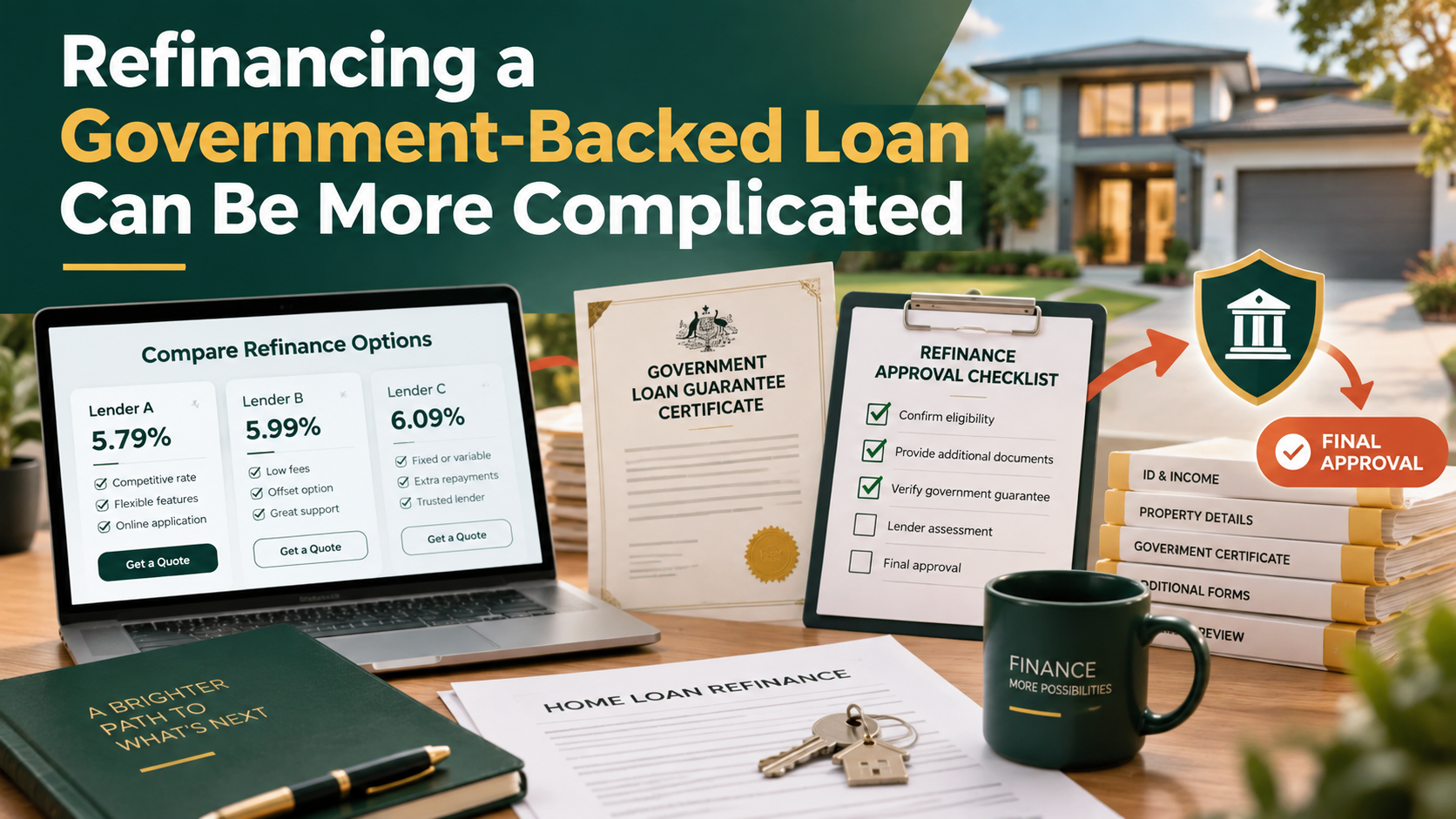
Borrowers who entered through a government guarantee should not assume they can simply move any existing guarantee to any lender or loan structure.
Scheme conditions, participating-lender requirements and ongoing eligibility need to be considered.
The current Australian Government scheme requires applications to go through participating lenders and makes clear that borrowers must continue satisfying relevant ongoing obligations for the guarantee to remain applicable.
Where a refinance sits outside the relevant guarantee arrangement, normal high-LVR lending conditions can become relevant, including potential LMI.
That makes professional assessment particularly important before changing lenders.
Serviceability Can Create a Second Mortgage Prison
Equity is only one part of the refinance problem.
Even if a property's valuation is acceptable, the borrower still needs to pass the new lender's affordability assessment.
APRA currently maintains a mortgage serviceability buffer of 3 percentage points.
That means lenders generally assess whether a borrower could continue servicing the mortgage at a materially higher interest rate than the actual loan rate offered.
Parliamentary evidence has previously highlighted the situation where borrowers comfortably paying an existing mortgage can nevertheless fail the assessment required to refinance into a potentially cheaper product.
This creates an apparent contradiction:
The borrower can afford the current expensive mortgage.
But they may not qualify for a cheaper mortgage.
That is another form of mortgage prison.
Higher Rates Have Made That Problem More Relevant
The RBA cash-rate target currently sits at 4.35%, effective from 12 August 2026.
The next decision is due on 29 September.
The RBA says the three cash-rate increases delivered earlier this year have flowed through into mortgage rates, pushing scheduled mortgage repayments relative to household disposable income close to their 2024 peak.
So some borrowers face:
higher repayments,
less equity,
and tougher refinance assessments
at exactly the same time.
Falling Prices Can Hurt Even If You Are Not Planning to Sell
Homeowners sometimes assume falling property values matter only when selling.
That is not necessarily true.
Your home's value also affects the security behind your mortgage.
That can influence refinancing.
It can influence whether you can release equity.
It can affect investment-property plans.
It can alter borrowing capacity for another purchase.
And it can affect the pricing available from some lenders.
For recent buyers, monitoring the equity position can therefore be useful even when there is no intention to sell.
Should Low-Equity Borrowers Simply Stay With Their Existing Bank?
Not automatically.
Having limited equity does not mean there are no options.
The first step may actually be talking to the current lender.
Existing customers can sometimes request a pricing review without refinancing.
If the lender agrees to reduce the rate, the borrower may obtain savings without:
changing banks,
paying discharge costs,
arranging another mortgage,
or triggering new-LMI considerations.
There is no guarantee the lender will reduce the rate.
But it is worth understanding the available options before assuming a full refinance is the only solution.
A Mortgage Broker Can Compare More Than Interest Rates
This is where mortgage advice becomes particularly valuable.
A borrower with strong equity and straightforward income may be able to compare headline rates relatively easily.
A low-equity borrower has more moving parts.
A mortgage broker can help compare:
current property valuation,
current loan balance,
effective LVR,
available lender policies,
potential LMI,
refinance costs,
serviceability,
loan features,
and the actual saving after switching costs.
The cheapest advertised rate is not always the cheapest practical solution.
Could a Different Valuation Change the Outcome?
Potentially.
Property valuations can vary depending on the property, recent comparable sales and the lender's valuation methodology.
A borrower should never assume a particular valuation will be achieved.
But understanding the likely current value is an important first step before concluding that refinancing is impossible.
Different lenders can also have different valuation processes.
For some borrowers, obtaining a realistic valuation assessment before submitting multiple applications can prevent unnecessary credit enquiries and wasted application costs.
Making Extra Repayments Can Help Rebuild Equity

If financially appropriate, additional principal repayments can gradually lower the outstanding balance and therefore improve the LVR.
Money sitting in an offset account can also reduce interest costs, although an offset does not necessarily change the loan balance used by every lender for all LVR purposes in the same way as an actual principal reduction.
Borrowers therefore need to distinguish between:
reducing interest,
and reducing the contractual mortgage balance.
Both can be financially useful, but they may have different implications when preparing for a future refinance.
Waiting Can Sometimes Improve the Position
Refinancing does not have to happen immediately.
A borrower may improve their position over time if:
the mortgage balance falls,
income rises,
other debts are repaid,
credit-card limits are reduced,
property values stabilise or recover,
or lender policies change.
Waiting is not always the best answer, particularly if the existing mortgage is significantly overpriced.
But sometimes the best mortgage strategy is to create a plan for becoming refinance-ready rather than forcing an expensive refinance today.
Beware of Resetting the Loan Term
Borrowers under repayment pressure should also be careful when comparing refinance offers.
A new lender may show a much lower monthly repayment partly because the mortgage has been reset to a new 30-year term.
That can improve short-term cash flow.
But it can also keep the borrower in debt substantially longer and increase total lifetime interest.
The comparison should therefore include:
the rate,
monthly repayment,
remaining term,
new term,
switching costs,
and total long-term interest.
A lower monthly repayment alone does not necessarily mean a cheaper loan.
Negative Equity Does Not Automatically Mean Mortgage Default
Falling property values can sound alarming.
But negative equity and repayment difficulty are different issues.
A borrower can technically have negative equity while continuing to make every repayment.
Problems become more serious if the borrower is forced to sell while the property's value is below the mortgage balance.
The RBA has repeatedly noted that employment, income and the ability to service debt are critical factors affecting mortgage performance.
So borrowers should avoid assuming that declining property values automatically mean financial failure.
The practical issue for many households is reduced flexibility.
They may have fewer refinancing options, less ability to release equity and less freedom to sell without potentially crystallising a loss.
Victoria and Tasmania Appear Particularly Exposed
The Aussie Home Loans analysis indicates Victoria and Tasmania have among the highest shares of recent buyers with low equity.
That is consistent with the broader pattern of uneven property-market performance.
Different states and suburbs experienced dramatically different growth rates during the previous housing upswing.
The current downturn is also affecting markets differently.
That reinforces an important point:
There is no single "Australian property market."
A borrower's equity position ultimately depends on the specific property they purchased, the price paid, their initial deposit, repayments since purchase and the current value of that individual property.
What Recent Buyers Should Check Now
If you purchased from 2023 onward, there are several useful numbers worth knowing.
First, your current mortgage balance.
Second, a realistic estimate of your property's present value.
Third, your approximate LVR.
Fourth, the interest rate you're currently paying.
Fifth, whether your lender offers an internal pricing review.
Sixth, what switching costs may apply.
Seventh, whether your income and expenses would satisfy today's refinance assessment.
Knowing these numbers does not mean you need to refinance.
It means you can make a decision using your actual position rather than assuming you're either trapped or free to switch.
The Bigger Lesson: Falling Home Prices Change More Than Your Property's Paper Value
A housing downturn can appear positive for future buyers because homes become cheaper.
For existing recent buyers, the effect can be very different.
Their purchase price is already locked in.
Their mortgage already exists.
So when the property's value falls, the main immediate effect can be a reduction in equity.
For someone who purchased with a small deposit, that can increase the LVR surprisingly quickly.
The result can be a difficult combination:
Your mortgage rate feels expensive.
You find a cheaper rate elsewhere.
But your reduced equity makes accessing that cheaper loan harder.
That is the essence of mortgage prison.
You May Still Have Options
The most important message for borrowers is that low equity should not automatically be interpreted as having no alternatives.
Options may include:
requesting a better rate from the existing lender,
reviewing other lenders that accept higher LVRs,
checking whether government guarantee arrangements remain relevant,
reducing other debts,
improving serviceability,
making additional principal repayments,
building equity over time,
or waiting until the refinance produces a better overall outcome.
Which option is appropriate depends entirely on the borrower.
Worried That Falling Property Prices Have Reduced Your Refinancing Options?
At Loan & Own Mortgages, we can help Australian homeowners review their existing home loan and understand how their current equity position affects refinancing.
That can include reviewing your estimated LVR, current mortgage rate, lender options, potential LMI, serviceability and the actual cost of switching.
A cheaper rate is valuable only if you can access it and if switching genuinely improves your financial position.
Before assuming you're stuck with your current lender, understand what options may still be available.
Speak with Loan & Own Mortgages to review your mortgage and refinancing position.
Data sources
Aussie Home Loans analysis, reported 13 September 2026: 20.7% of homeowners who purchased since July 2023 have less than 20% equity. Their average mortgage balance is approximately $646,000 compared with approximately $536,000 for borrowers with stronger equity positions. Victoria and Tasmania were among the markets with the greatest low-equity exposure.
Cotality September 2026 housing data: Australian home values fell 0.9% in August and are now 3.6% below the March peak. Around 93% of capital-city suburbs recorded declining values through winter.
Reserve Bank of Australia: The cash-rate target is currently 4.35%, with the next monetary-policy decision scheduled for 29 September 2026.
RBA Financial Stability Review, March 2026: Very-high-LVR first-home buyer lending increased following expansion of the government deposit guarantee scheme.
APRA: Residential mortgage risk treatment varies according to loan-to-value ratio, with different categories applying above 80%, 90% and 100% LVR.
Australian Government 5% Deposit Scheme: Eligible buyers can purchase with deposits from 5%, or 2% for eligible single parents and guardians, without LMI under the guarantee arrangement.
This article contains general information only and does not constitute personal financial, credit, investment, tax or legal advice. Property values, lender valuations, LMI requirements, refinancing eligibility and loan pricing vary according to individual circumstances and lender policy.
