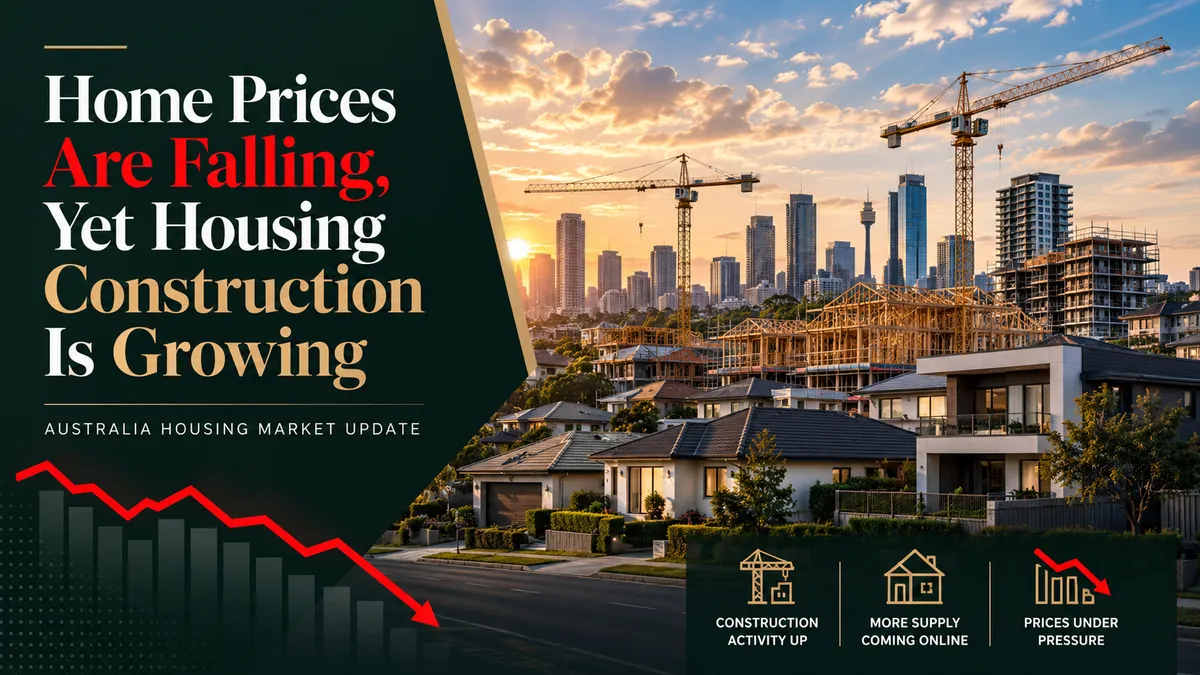
Home Prices Are Falling, Yet Housing Construction Is Growing 5.8%. What’s Going On?
Home Prices Are Falling, Yet Housing Construction Is Growing 5.8%. What’s Going On?
At first glance, Australia's latest housing numbers seem contradictory.
Property prices are falling across much of the country.
At the same time, investment in housing construction is growing.
According to the Australian Bureau of Statistics' June 2026 National Accounts, private dwelling investment increased 1.6% during the June quarter and was 5.8% higher than a year earlier.
Meanwhile, Cotality's national Home Value Index fell 0.9% in August, marking the fifth consecutive month of decline. National home values are now approximately 3.6% below their March 2026 peak.
Sydney has been hit particularly hard. Values dropped another 1.4% in August and are now 7.1% below the February peak.
So how can housing construction be expanding while property prices are falling?
The answer is that Australia's housing market is not one single cycle.
Construction activity, property prices, buyer demand, lending conditions and housing supply all respond to economic conditions at different speeds.
Understanding those differences is particularly important for home buyers, investors, developers and anyone considering finance in the current market.
The Numbers Behind Australia's Housing Market
The contrast becomes clearer when we put the latest figures side by side.
Indicator | Latest result |
|---|---|
Australian GDP, June quarter 2026 | +0.4% |
GDP growth, year to June 2026 | +2.1% |
Private dwelling investment, June quarter | +1.6% |
Private dwelling investment, annual | +5.8% |
National home values, August | -0.9% |
National home values from March peak | -3.6% |
Sydney home values, August | -1.4% |
Sydney home values from February peak | -7.1% |
Capital city suburbs recording winter price falls | 93% |
National median dwelling value, Cotality | $912,885 |
The ABS reported that Australia's economy grew 0.4% during the June quarter and 2.1% through the year, while dwelling investment was one of the areas continuing to expand.
But Australia's established property market has been responding to a very different set of forces.
Why Construction Can Rise While Home Prices Fall
The most important point is that housing construction activity and established property prices measure completely different things.
Home price indexes largely tell us what is happening to the value of existing residential property.
Dwelling investment in the National Accounts captures economic activity associated with residential construction.
Those two markets are connected, but they do not move in perfect synchronisation.
A construction project underway today may have been:
purchased years earlier
approved months earlier
financed under different market conditions
pre-sold before the recent housing downturn
delayed by planning or construction bottlenecks
progressing through a multi-year development schedule
This creates a significant lag between changes in property demand and changes in actual construction activity.
A fall in today's auction prices does not suddenly stop every apartment project, housing development or residential construction project already underway.
That lag is one of the biggest reasons construction investment can remain positive even while established property values decline.
Australia's Construction Pipeline Is Still Moving
Recent building approval data provides another useful piece of the picture.
ABS data shows 17,687 dwellings were approved in July 2026.
Although this represented a 3.6% monthly decline, approvals were still 9.0% higher than July 2025.
Private sector house approvals reached 10,199, while approvals for private dwellings excluding houses, including apartments and other higher-density housing, reached 7,119.
More importantly, private dwellings excluding houses were 19.9% higher than a year earlier.
That tells us something important.
The construction pipeline has not disappeared simply because established house prices have started falling.
The pipeline of projects can continue feeding construction activity even when current buyers become more cautious.
But Construction Growth Does Not Mean the Housing Market Is Booming
This distinction matters.
A 5.8% annual increase in dwelling investment should not automatically be interpreted as evidence of another property boom.
Other housing indicators are considerably softer.
Cotality reported that 93% of capital city suburbs recorded falling values through winter, compared with only 45.8% during autumn.
That suggests the downturn has broadened substantially.
It is no longer simply a weakness affecting premium Sydney and Melbourne properties.
Cotality reported August monthly falls of:
Sydney: -1.4%
Melbourne: -1.1%
Canberra: -1.1%
Brisbane: -1.0%
Adelaide: -0.8%
Perth: -0.8%
Hobart: -0.2%
Darwin was the exception, increasing 0.6%.
Australia is therefore experiencing something more nuanced than either a nationwide construction boom or a property crash.
Buyer Demand Has Weakened
Another reason established home values are falling is weaker transaction activity.
Cotality estimates that quarterly home sales are currently running 15.5% below the same period last year and 11.5% below the five-year average.
Sydney, Brisbane and Perth have experienced some of the sharpest reductions, with estimated transaction volumes more than 20% below year-earlier levels.
When fewer buyers are competing for properties, sellers can lose some negotiating power.
At the same time, the supply of properties available for sale has increased.
Across the capital cities, Cotality reported advertised listings during the four weeks to 30 August were approximately 24% higher than a year earlier and 8% above the five-year average.
That combination is significant:
Lower buyer demand + more properties for sale = greater pressure on prices.
This can happen while builders remain busy completing projects already moving through the development pipeline.
Interest Rates Are Playing a Major Role
Financing conditions are another important part of the story.
The Reserve Bank of Australia's cash rate target currently sits at 4.35%, effective from 12 August 2026.
Higher borrowing costs affect housing markets in several ways.
For buyers, they can reduce borrowing capacity and increase monthly mortgage repayments.
For investors, they can change the economics of holding leveraged property.
For developers, they can increase project funding costs.
For existing mortgage holders, they can place additional pressure on household cash flow.
And for prospective buyers, uncertainty around rates can encourage people to postpone purchasing decisions.
That helps explain why established property prices can weaken relatively quickly.
Construction activity tends to respond more slowly because many projects are already committed.
The Construction Pipeline Works With a Delay
Consider a hypothetical apartment development.
The developer may have acquired the land several years ago.
Planning approval may have taken another year.
Pre-sales may have commenced when property sentiment was much stronger.
Finance could then have been approved before construction began.
By the time the building is physically under construction, the property market could look completely different.
The same applies, on a smaller scale, to houses.
A buyer may purchase land and sign a building contract months before work begins. Even if house prices weaken while the property is being constructed, the project does not simply disappear from construction statistics.
This is why construction is often a lagging indicator of housing demand.
Today's construction numbers partly reflect yesterday's decisions.
Today's property prices reflect today's balance between buyers and sellers much more quickly.
New Housing Supply Could Eventually Influence Prices Too
There is another side to the equation.
If elevated construction activity eventually produces more completed housing, that additional supply can influence market conditions.
Australia has faced well-documented housing supply pressures, particularly in markets experiencing strong population growth.
More housing construction can help increase available dwelling stock over time.
But supply does not arrive instantly.
A dwelling must move through multiple stages:
Planning → Approval → Finance → Construction → Completion → Settlement
Each step can take months or years.
That means rising dwelling investment today does not automatically translate into significantly more homes available for purchase tomorrow.
Falling Prices Do Not Mean Every Australian Property Market Is Falling Equally
The national figures also hide enormous differences between markets.
For example, despite Perth recording a monthly decline in August, Cotality's data still showed Perth values 15.6% higher than a year earlier.
Brisbane remained 10.8% higher annually, Adelaide 8.6% higher, and Darwin 14.6% higher.
By comparison:
Sydney was 4.6% lower than a year earlier, while Melbourne was 4.7% lower.
That is a major reminder for property buyers and investors.
There is no single "Australian property market."
There are dozens of markets responding differently to:
employment
population growth
housing supply
affordability
investor demand
infrastructure
borrowing conditions
local economic activity
Even within Sydney, conditions can vary substantially between suburbs, property types and price segments.
What Could This Mean for Home Buyers?
Falling prices can create opportunities, but price alone should not determine whether someone should buy.
A cheaper property does not necessarily mean it has become more affordable if borrowing costs have increased at the same time.
For prospective home buyers, the more important questions may include:
What is your current borrowing capacity?
How much deposit will you require?
What repayments can you comfortably manage?
How would different interest rates affect those repayments?
Which lenders may assess your income most favourably?
Is a pre-approval appropriate before searching seriously?
Are you buying for several years or reacting to short-term market movements?
Trying to perfectly time the bottom of a property cycle is extremely difficult.
A better starting point is usually understanding your financial position and lending options before deciding whether a particular opportunity suits your circumstances.
What Could It Mean for Property Investors?
Investors also need to separate price movements from the underlying investment case.
Falling values may create negotiating opportunities, but borrowing costs, rental income, cash flow, tax considerations and future supply all matter.
An investor purchasing in an area with a large volume of new stock approaching completion may face very different conditions from an investor targeting a supply-constrained location.
Investors should therefore look beyond national headlines and examine:
local supply pipelines
vacancy rates
rental demand
comparable sales
expected cash flow
finance structure
borrowing capacity
holding costs
long-term investment objectives
Finance structure becomes particularly important when investors already hold multiple properties because one lending decision can influence the borrowing capacity available for future purchases.
What About People Building a New Home?
For borrowers considering a new build, the current environment can also create a different set of considerations.
Construction loans operate differently from ordinary loans used to purchase completed properties.
Funding is generally released progressively as construction reaches agreed stages rather than being advanced entirely at settlement.
The lender may also assess:
land value
building contract
approved plans
project costs
borrower contribution
valuation
builder details
contingency requirements
servicing capacity
LNO Mortgages assists borrowers with construction loan enquiries as part of its wider residential lending services. Lending availability and requirements will depend on the borrower, property, project and lender assessment.
So, Is Australia's Housing Market Strong or Weak?
The answer depends on which part of the housing market you are looking at.
Construction activity: comparatively resilient.
Established property prices: currently weakening.
Building approvals: down month to month in July, but still higher than a year earlier.
Buyer demand: softer.
Properties available for sale: higher.
Borrowing conditions: challenging.
All of those things can be true simultaneously.
That is why describing Australia's housing market simply as "up" or "down" can be misleading.
The latest data instead points to a market undergoing a transition.
Projects approved and financed during earlier conditions are continuing to move through Australia's construction pipeline while today's buyers respond much more quickly to affordability pressures, interest rates and changing sentiment.
The Bigger Lesson for Borrowers
The current housing environment highlights an important principle.
Property conditions and lending conditions are not always moving in the same direction.
A falling property market does not automatically mean financing has become easier.
Likewise, rising construction activity does not necessarily mean buyers should rush into the market.
For borrowers, the focus should remain on understanding:
borrowing capacity
repayment affordability
lender policy
loan structure
deposit requirements
available buffers
future financial goals
The right finance decision depends much more on the individual borrower than on a single property-market statistic.
Looking to Buy, Build, Invest or Review Your Finance?
At LNO Mortgages, we help home buyers, property investors, self-employed borrowers and business owners understand their lending options and structure finance around where they are trying to go.
Whether you are considering an established property, a new build, an investment property or simply want to understand your borrowing capacity before making your next move, having the finance conversation early can provide much greater clarity.
Speak with LNO Mortgages to review your circumstances, borrowing position and potential lender options before making your next property decision.
Data Sources
Australian Bureau of Statistics, Australian National Accounts: National Income, Expenditure and Product, June 2026
Released 2 September 2026. The ABS reported GDP growth of 0.4% for the June quarter, with private dwelling investment increasing 1.6% during the quarter and 5.8% through the year.
Cotality, Home Value Index, August 2026
Cotality's national Home Value Index fell 0.9% in August, with national values 3.6% below their March peak and Sydney 7.1% below its February peak.
Australian Bureau of Statistics, Building Approvals, July 2026
Total dwelling approvals reached 17,687, down 3.6% from June but 9.0% higher than a year earlier.
Reserve Bank of Australia
Cash rate target: 4.35%, effective 12 August 2026.
This article contains general information only and does not constitute financial, investment, tax or legal advice. Lending eligibility, borrowing capacity, interest rates and loan options depend on individual circumstances and lender assessment.
