
Home Ownership Is Becoming a Generational Wealth Divide in Australia
Home Ownership Isn’t Just About Having Somewhere to Live. It’s Becoming a Generational Wealth Divide.
For generations of Australians, buying a home has represented much more than securing a roof over their heads.
A mortgage gradually converts repayments into ownership.
Over time, the loan balance can decline.
The property may increase in value.
Eventually, homeowners can enter retirement with a significant asset and substantially lower housing costs than someone still renting.
That pathway has helped make owner-occupied housing one of the most important components of Australian household wealth.
But Australia’s latest long-term economic report suggests access to that pathway is becoming increasingly uneven between generations.
Treasury’s 2026 Intergenerational Report looks ahead to 2065–66 and examines the major forces expected to reshape the Australian economy, including artificial intelligence, geopolitical fragmentation, the energy transition, an ageing population and industrial transformation. It also contains a dedicated focus on intergenerational equity. (Treasury)
One of the clearest pressure points is housing.
Younger Australians are increasingly reaching adulthood without experiencing the same early home-ownership and wealth gains available to many previous generations. (ABC News)
And that matters because delaying home ownership can affect finances for decades.
Australia Would Have Around 250,000 More Young Homeowners if 1981 Ownership Rates Had Continued
One of the most striking figures associated with the new report concerns Australians aged 25 to 34.
According to Treasury analysis reported by ABC, Australia would have roughly 250,000 additional homeowners in that age group today if home-ownership rates had remained at their 1981 level. (ABC News)
That is not merely a housing statistic.
It represents hundreds of thousands of households that may have otherwise begun accumulating housing equity earlier in life.
The longer-term generational trend is also visible in ABS Census analysis.
Among Australians aged 25 to 39, 65.8% of Baby Boomers were homeowners when that generation was the same age in 1991.
For Generation X in 2006, the figure was 62.1%.
For Millennials in 2021, it had fallen to 54.6%. (Australian Bureau of Statistics)
The decline has happened despite younger Australians becoming substantially more educated and remaining strongly attached to the workforce. (Australian Bureau of Statistics)
That is why the housing challenge increasingly looks like a wealth challenge rather than simply an accommodation challenge.
Why Home Ownership Has Traditionally Been Such a Powerful Wealth-Building Tool
Consider what happens after someone buys a home.
Part of each principal-and-interest mortgage repayment reduces the amount owed.
That gradually increases the owner’s equity.
If the property also increases in value over the long term, the owner may receive an additional equity benefit.
That combination can create a form of forced saving.
Someone renting may also build substantial wealth through shares, superannuation, businesses or other investments.
Home ownership is certainly not the only route to financial security.
But historically, it has been one of Australia’s most widely used.
Treasury’s broader analysis indicates real household net worth increased from around $500,000 in 1993–94 to more than $1.3 million by 2019–20, but much of that wealth growth accrued to older households. (ABC News)
So when younger households enter home ownership later, the issue is not simply that they rent for longer.
They may also begin the housing-equity accumulation process later.
Buying Five or Ten Years Later Can Change the Financial Timeline
Imagine two otherwise similar households.
One purchases a home in their early 30s.
The other does not purchase until their early 40s.
The second household has not necessarily made a poor financial decision. Their circumstances may simply be different.
But their timelines are.
The first household potentially has an additional decade to reduce its mortgage principal before retirement.
It also has an additional decade during which any long-term changes in property value can affect its equity.
The second household may still be carrying a larger mortgage balance later in life.
That can influence:
retirement planning, the ability to help children financially, investment decisions, refinancing options and housing security later in life.
This is why the timing of home ownership can have consequences well beyond the date someone receives the keys.
House Prices Have Risen Much Faster Than Incomes
Treasury’s housing analysis helps explain why younger buyers are finding entry so difficult.
ABC’s coverage of the report says Australian house prices have increased by roughly 400% since 1999, more than twice the pace of average income growth over the period. (ABC News)
That matters enormously for deposits.
If house prices rise much faster than earnings, the amount required for a traditional 20% deposit can increase faster than a household’s capacity to save it.
Meanwhile, rent and ordinary living expenses continue.
For buyers already facing elevated mortgage rates, the difficulty does not end once the deposit is saved.
They also need to satisfy lender serviceability requirements and demonstrate that their income can support repayments.
So housing affordability effectively has two barriers:
getting enough money together to enter the market, and qualifying for enough finance to complete the purchase.
The Deposit Is Only One Part of the Challenge
A prospective buyer might spend years building a deposit only to discover that borrowing capacity has changed.
Lenders assess factors including income, existing debts, credit-card limits, household expenses, dependants and the proposed mortgage repayments.
Interest rates therefore matter enormously.
When mortgage rates rise, the same household income may support a smaller loan.
That creates a difficult situation for first-home buyers.
Property prices might fall slightly, yet borrowing capacity can fall at the same time.
A cheaper house is not necessarily a more affordable house if the financing becomes materially more expensive.
This distinction has become particularly important in Australia’s current market.
Housing Supply Is Part of the Problem Too
Treasury does not attribute the housing challenge to one factor.
The report says population growth and smaller household sizes have increased demand for housing while weak construction productivity has constrained supply. ABC reports that Australia is currently building homes at roughly half the productivity level achieved 30 years ago. (ABC News)
That is important because Australia cannot solve long-term affordability simply by changing mortgage rates.
Interest rates influence how much people can borrow.
They do not directly create land, infrastructure, skilled construction workers or new homes.
Housing affordability therefore depends on both finance and physical housing supply.
For buyers, those two forces can move in opposite directions.
Higher rates may weaken property demand.
But they can also increase financing costs for builders and developers.
Slower Population Growth Does Not Automatically Solve Housing Affordability
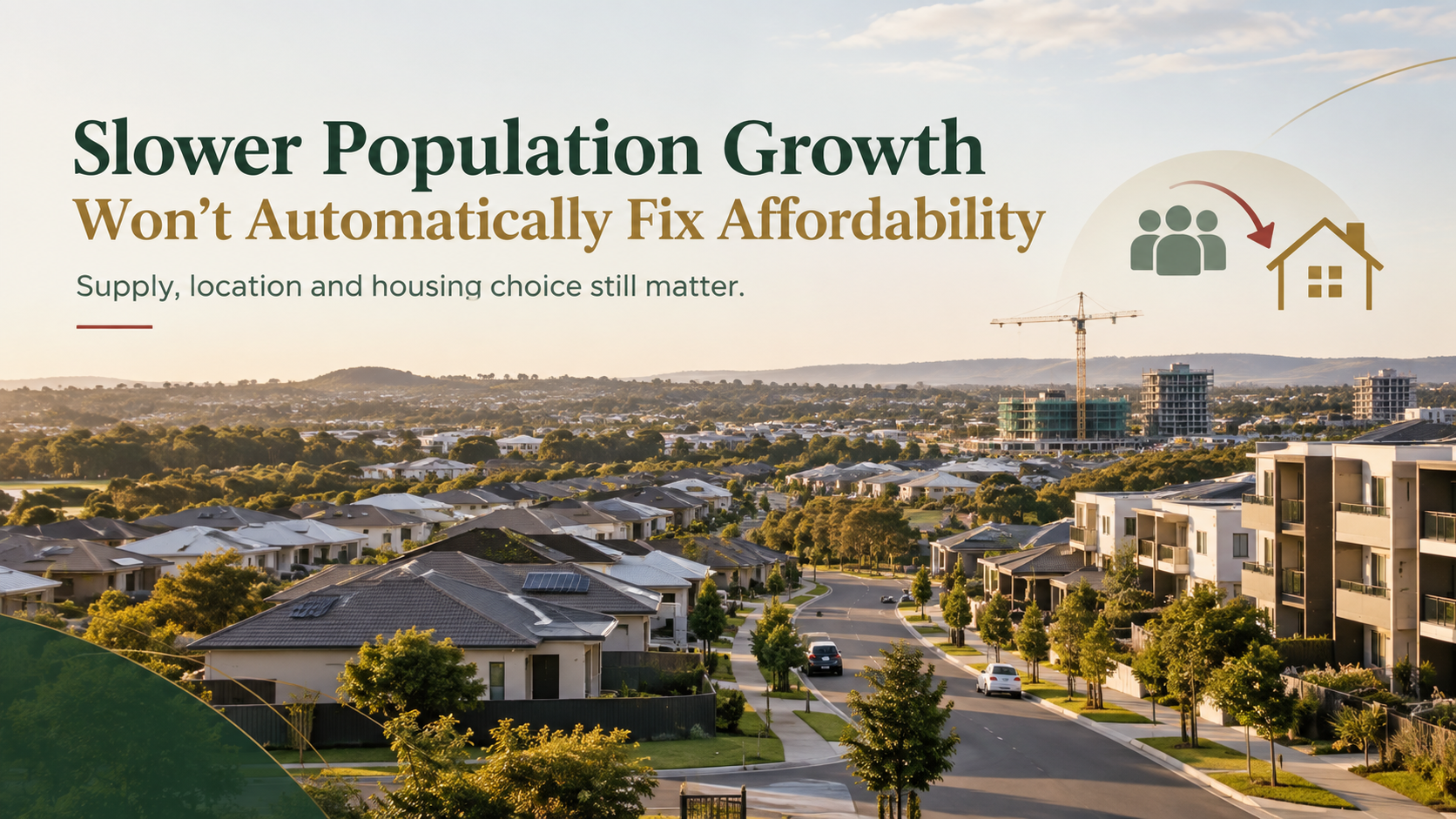
The Intergenerational Report expects Australia’s population to grow more slowly over the next four decades.
Treasury projects average population growth of around 0.9% annually over the long term, around one-third slower than the previous 40 years. The population is expected to remain below 40 million in 2066, while deaths are projected to eventually exceed births as fertility falls and the population ages. (Treasury Ministers)
At first glance, slower population growth might appear to reduce future housing pressure.
But the equation is more complicated.
Housing demand depends not only on population.
Household size matters.
Where people want to live matters.
Employment centres matter.
Migration patterns matter.
The type of housing being built matters.
And existing supply may not be located where demand is strongest.
Treasury itself highlights smaller households as one reason housing demand has remained strong. (ABC News)
So slower national population growth does not guarantee that homes in Sydney, Melbourne, Brisbane or other employment-rich markets suddenly become affordable.
Younger Australians Are Missing More Than Property Growth
Treasury’s concern extends beyond housing.
According to the Intergenerational Report coverage, younger Millennials are reaching their 30s without receiving the same early-career increases in real disposable income enjoyed by those born in the 1980s. (ABC News)
At the same time, housing has become harder to access.
That creates a double challenge.
Income growth is weaker at the stage of life when people traditionally begin accumulating assets.
And the price of one of Australia’s largest household assets has moved further away from earnings.
That makes it harder to begin building wealth early.
Treasury also estimates that only around two-thirds of Australians born from the 1960s onwards are economically better off than their parents, compared with about 80% of those born in the 1950s. (ABC News)
These are broad population trends, not predictions for individual households.
But they help explain why housing has become such an important part of the intergenerational-equity debate.
Investor Housing Is Also Part of Treasury’s Analysis
The Intergenerational Report also discusses the structure of housing investment.
Treasury says 80% to 90% of investor housing lending since 2019 has gone into purchasing existing properties rather than newly constructed dwellings. It also argues that existing tax concessions have influenced the balance between investor ownership and prospective owner-occupiers. (ABC News)
Those conclusions form part of a broader and politically contested housing-policy debate.
Different analysts place different weight on tax settings, planning restrictions, construction costs, infrastructure availability, population growth, credit conditions and interest rates when explaining Australian housing affordability.
For a borrower, the practical point is simpler:
housing affordability is the outcome of many forces, not one.
First-Home Buyers Are Competing Against Time as Well as Price
When people talk about property affordability, they usually discuss the purchase price.
But time is another important variable.
Suppose it takes someone an additional five years to save a deposit.
During those five years:
property prices may change, interest rates may change, lending rules may change, rents may rise, income may increase and their personal circumstances may change.
That makes the first-home-buyer journey much more complicated than simply saving 20% of today’s property price.
The target itself can move.
A buyer therefore needs to understand whether waiting for the traditional 20% deposit is actually necessary for their circumstances.
Depending on eligibility and lender policy, alternatives can include lower-deposit loans, government guarantee programs, shared-equity arrangements, family guarantees or different property-price targets.
Each has trade-offs and risks, so eligibility and long-term costs matter.
A 20% Deposit Is Not a Universal Requirement
One common misconception deserves attention.
You do not necessarily need a 20% deposit to purchase a property in Australia.
Many lenders can consider smaller deposits.
However, a higher loan-to-value ratio can affect lender choice, interest rates and whether lenders mortgage insurance applies.
Government schemes can also change the equation for eligible first-home buyers.
That means someone who assumes they must save 20% before speaking to a lender could potentially delay their purchase unnecessarily.
The opposite mistake is also possible.
Buying with the smallest available deposit simply because it is possible may leave the borrower with very little equity and a larger mortgage.
The right deposit strategy depends on income, expenses, property price, risk tolerance and future plans.
Waiting for Property Prices to Fall Can Carry Its Own Risks
Another strategy some buyers use is waiting for a major housing correction.
Sometimes prices do fall.
But affordability depends on more than price.
If a property falls 5% while mortgage rates rise sufficiently to reduce borrowing capacity by more than 5%, the buyer may not actually be in a stronger position.
Likewise, a buyer who waits several years for prices to decline may spend additional years renting while delaying mortgage principal repayments.
That does not mean everyone should rush into the market.
It means attempting to perfectly time the housing cycle can be difficult.
A more useful question is often:
Can I purchase an appropriate property with repayments I can comfortably manage?
Borrowing the Maximum Is Not the Same as Buying Affordably

This distinction becomes especially important for younger buyers.
A lender might approve a certain mortgage amount.
That does not mean borrowing that full amount is necessarily appropriate.
A comfortable mortgage should leave room for the rest of life.
That includes:
unexpected expenses, future rate changes, holidays, children, career changes, emergencies, renovations and savings.
The strongest borrowing position is therefore not necessarily the household with the largest approval.
It may be the household that understands its realistic repayment limit before searching for property.
Parents and Family Wealth Can Increasingly Affect Who Buys First
As deposits become harder to accumulate, family assistance can become more important.
Some buyers receive gifted deposits.
Others use parental guarantees.
Some live at home longer while saving.
Others receive no family assistance at all.
This can create another layer of intergenerational inequality.
People who already come from property-owning families may be able to enter the housing market earlier, while those without access to family assets may need considerably more time.
That difference can then compound across another generation.
Housing wealth therefore has the potential to influence not only the current owner but the financial opportunities available to their children.
Home Ownership Also Matters at Retirement
The impact becomes particularly significant later in life.
Someone who reaches retirement with a fully paid-off home may face very different housing costs from someone still paying rent.
Australia’s retirement system has historically operated alongside relatively high home-ownership rates.
That relationship becomes increasingly important as the population ages.
Treasury projects the number of Australians aged over 85 to triple by 2066, while Australians are also expected to live longer and spend more years in retirement. (Treasury Ministers)
If future generations enter housing later and carry mortgages for longer, retirement housing security could become a bigger financial planning issue.
What Can Younger Buyers Actually Control?
First-home buyers cannot control nationwide house prices.
They cannot control population growth.
They cannot control RBA decisions.
And they cannot fix construction productivity.
But they can understand their own financial position.
That means knowing:
how much deposit they actually need, their realistic borrowing capacity, their comfortable monthly repayment, the debts affecting serviceability, available first-home-buyer programs, lender differences and the type of property that fits the budget.
A buyer who knows these numbers can make decisions based on their circumstances rather than headlines.
Why Lender Choice Matters More Than Many First-Home Buyers Realise
Not every bank assesses borrowers identically.
Lender policies can vary around overtime, bonuses, self-employed income, existing debts, credit limits and living expenses.
They can also differ significantly around lower-deposit lending.
That means two lenders can assess the same household differently.
For first-home buyers near the edge of affordability, those differences can materially affect the properties they can consider.
This is one reason speaking with a mortgage broker before attending dozens of inspections can save considerable time.
The Bigger Lesson: Delayed Home Ownership Can Become Delayed Wealth Building
Treasury’s new 40-year outlook puts Australia’s housing challenge into a much larger context.
Younger Australians are not simply finding houses expensive.
They are entering one of the country’s traditional wealth-building mechanisms later than previous generations.
Home ownership among younger adults has declined.
Housing prices have dramatically outpaced income growth.
And household wealth gains have increasingly been concentrated among older Australians. (ABC News)
That means Australia's affordability challenge can compound over time.
Someone who struggles to buy today may not simply spend several additional years renting.
They may begin accumulating housing equity later.
They may reach retirement with more housing debt.
And they may have less property wealth available to pass to the next generation.
That is why this conversation is bigger than property prices.
It is increasingly about who gets the opportunity to build wealth, and when.
Home Ownership Is Not the Only Path to Wealth, but Access Still Matters
It is important not to overstate the case.
Buying property is not guaranteed to produce wealth.
Property prices can fall.
Mortgage interest and ownership costs can be significant.
Renters can successfully accumulate substantial assets through superannuation, shares and other investments.
And buying an unsuitable property with an unaffordable mortgage can damage rather than improve someone's financial position.
The point is not that everyone must own property.
The issue highlighted by Treasury is whether younger Australians have comparable opportunities to previous generations to choose home ownership if it suits them.
The long-term data suggests that opportunity has become harder to access.
Thinking About Buying Your First Home?
At Loan & Own Mortgages, we help first-home buyers understand their borrowing position before they commit to a property.
That can include reviewing your deposit, calculating borrowing capacity, comparing lenders, exploring eligible first-home-buyer options and understanding how different loan structures could affect repayments.
You cannot control Australia’s property market.
But you can understand the options available to you.
And when housing access increasingly affects long-term wealth, knowing those options earlier can matter.
Speak with Loan & Own Mortgages to understand what your path to home ownership could look like.
Data sources
Australian Treasury’s 2026 Intergenerational Report was released on 21 September 2026 and projects Australia’s economy and Commonwealth budget through 2065–66. It identifies AI, geopolitical fragmentation, the energy transition, population ageing and industrial transformation as major long-term shifts, alongside a specific focus on intergenerational equity. (Treasury)
ABC’s analysis of the report says there would be approximately 250,000 more homeowners aged 25 to 34 if home-ownership rates had remained at 1981 levels. It also reports that house prices have increased roughly 400% since 1999, more than twice as quickly as average income, and that much of recent household wealth growth has been concentrated among older households. (ABC News)
Australian Bureau of Statistics generational Census analysis found home ownership among people aged 25 to 39 fell from 65.8% for Baby Boomers at that age, to 62.1% for Generation X, to 54.6% for Millennials. (Australian Bureau of Statistics)
Treasury projects Australia's population growth to average around 0.9% per year over the coming decades, with the population remaining below 40 million in 2066 and deaths eventually exceeding births as the population ages. (Treasury Ministers)
Treasury also says housing has become one of the most significant contributors to intergenerational wealth inequality; the government has linked its current housing and tax reforms to that assessment. The effectiveness and relative importance of different housing-policy approaches remain subjects of political and economic debate. (Treasury Ministers)
This article provides general information only and does not constitute personal financial, credit, investment, tax or legal advice. Property prices can rise or fall, and deposit requirements, borrowing capacity, lender policies and eligibility for government housing programs depend on individual circumstances.
