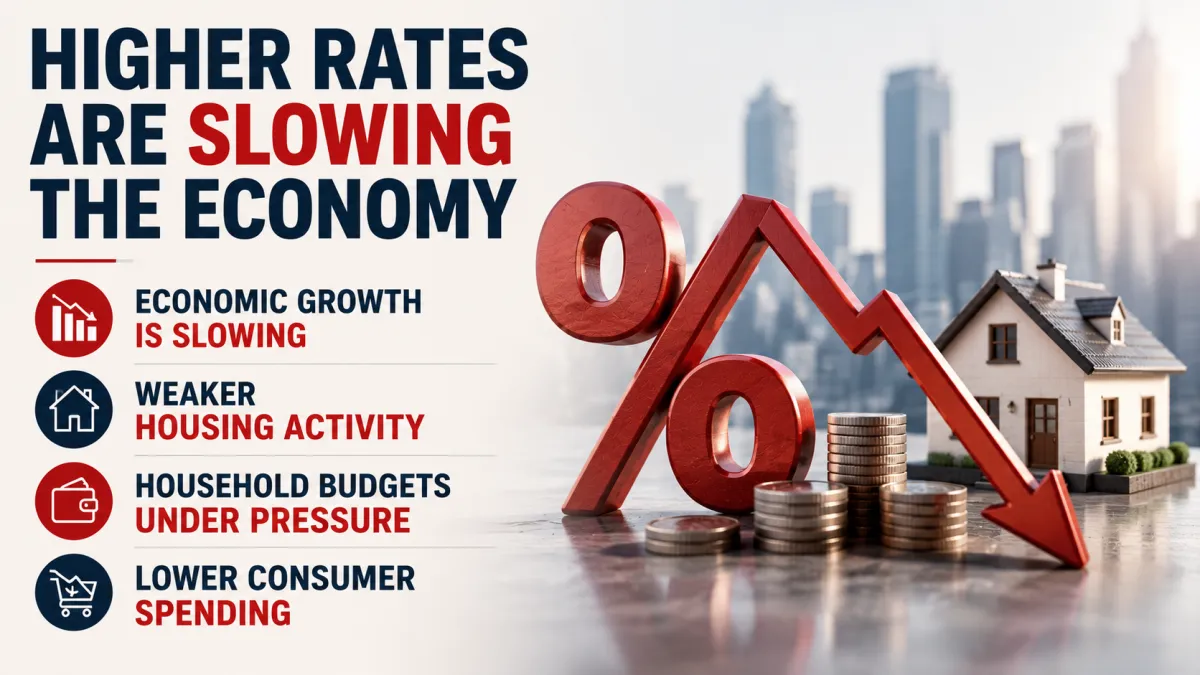
Higher Interest Rates Are Slowing the Australian Economy
Higher Rates Are Doing More Than Increasing Mortgage Repayments. They're Starting to Slow the Economy.
Higher interest rates are usually discussed in terms of one immediate impact: bigger mortgage repayments.
But the effects are now becoming much broader.
Commonwealth Bank of Australia (CBA) has warned that Australia's economy is slowing as elevated interest rates and inflation continue to put pressure on household budgets and economic activity. The warning comes as the Reserve Bank of Australia (RBA) also acknowledges that tighter financial conditions are beginning to restrain demand.
For homeowners, buyers and investors, this is an important reminder that interest-rate decisions eventually affect much more than individual mortgage repayments.
Three Rate Increases Are Working Through the Economy
The RBA has increased the cash rate three times during 2026, taking it to 4.35%. In August, the RBA held the rate steady but said the economy was slowing under tighter financial conditions.
Interest-rate changes don't affect the economy instantly.
They gradually flow through to mortgage repayments, borrowing capacity, household spending, business investment and property demand.
The RBA's June meeting minutes noted that banks had passed higher rates through to borrowers, scheduled mortgage repayments had risen and housing demand had eased.
We may now be seeing more of those effects emerge.
Household Budgets Are Under Pressure
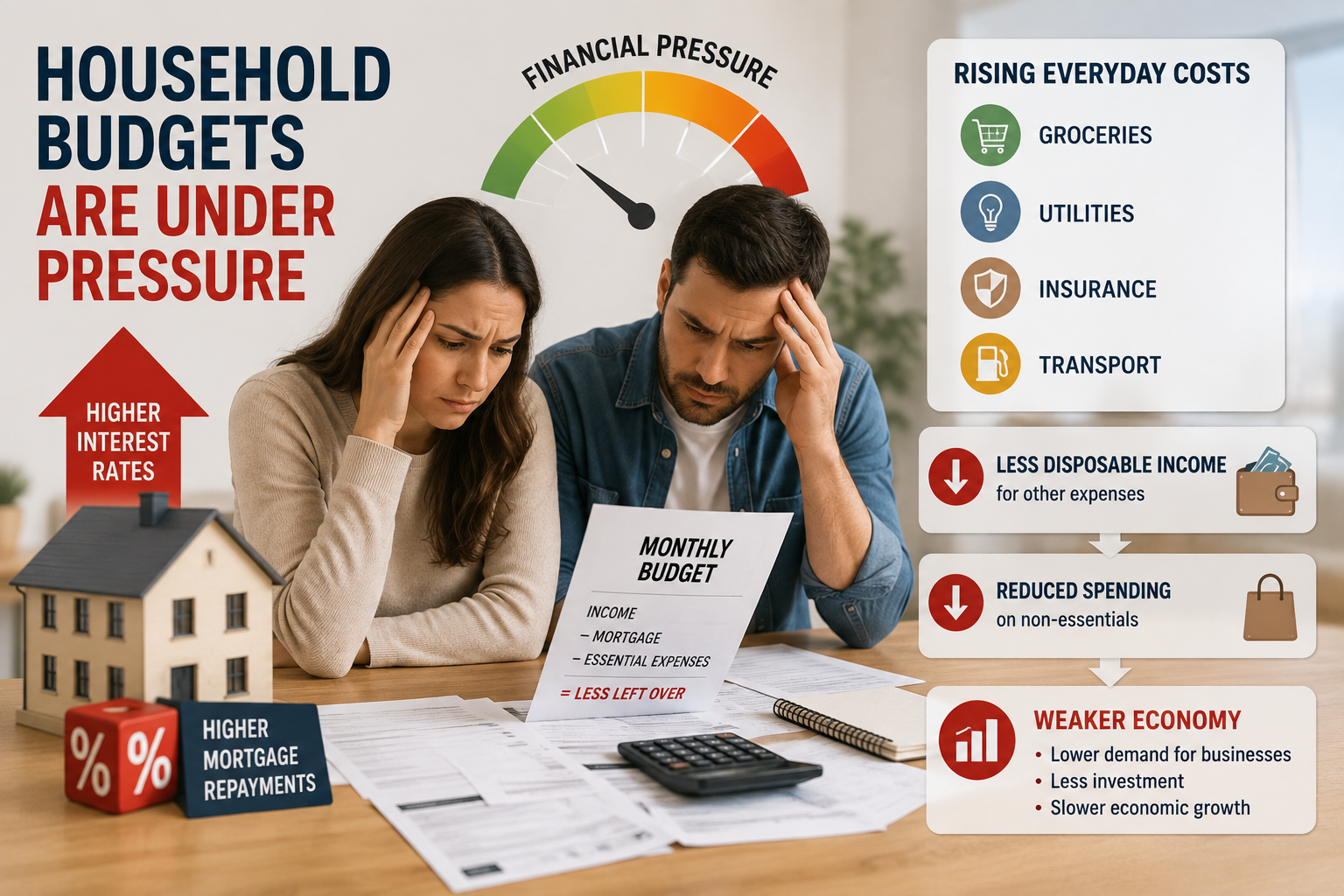
For households with variable-rate mortgages, higher interest rates can significantly increase monthly repayments.
That leaves less disposable income for other expenses.
At the same time, households continue to face elevated costs across essentials such as groceries, utilities, insurance and transport.
When mortgage repayments and everyday expenses consume a larger share of household income, families may respond by reducing discretionary spending.
That matters because household consumption represents a significant part of Australia's economy.
If enough households reduce spending simultaneously, businesses can experience weaker demand, which can eventually affect investment, hiring and economic growth.
CBA Is Seeing Signs of Financial Pressure
CBA's latest financial results provide another indication of the changing environment.
The bank reported loan impairment expenses of A$788 million for the year, up 9% from the previous year. CBA attributed the increase to cost-of-living pressures affecting Australian customers.
An increase in impairment charges doesn't mean most borrowers are experiencing financial difficulty.
However, it provides another useful indicator of how higher living and borrowing costs are affecting parts of the household sector.
CBA also reported a substantial decline in mortgage applications, another sign that housing activity is responding to changing economic conditions.
The Housing Market Is Feeling the Impact
Higher rates affect property markets in several ways.
Most importantly, they can reduce borrowing capacity.
When lenders assess a home-loan application, they need to determine whether the borrower can comfortably manage repayments. Higher interest rates generally mean higher assessed repayments, potentially reducing the amount someone can borrow.
That can influence:
How much buyers can offer for a property
Whether investors proceed with purchases
Demand for new mortgages
Refinancing decisions
Overall housing-market activity
Recent major-bank results have shown mortgage applications weakening, while auction clearance rates and property prices have also softened.
Why the RBA Wants Demand to Slow
Slowing economic demand isn't simply an unintended consequence of higher rates.
It's part of how monetary policy is designed to reduce inflation.
When demand exceeds the economy's capacity to supply goods and services, businesses can find it easier to increase prices.
Higher interest rates aim to reduce spending and borrowing, bringing demand and supply into better balance.
The RBA has said financial conditions are now restrictive and that slowing demand is necessary to reduce capacity pressures and bring inflation sustainably back toward its target.
The challenge is achieving that without weakening economic activity more than necessary.
What Does This Mean for Mortgage Holders?

The changing environment makes reviewing household finances increasingly important.
Borrowers shouldn't assume they need to wait for the RBA to cut rates before exploring their options.
Individual lenders can change their mortgage pricing independently based on competition, funding costs, risk and their appetite for new customers.
A home-loan review could help you understand whether:
Your current rate remains competitive
Refinancing could reduce repayments
Your existing lender may negotiate your rate
Your loan structure still suits your circumstances
Different features could improve cash-flow management
Even when refinancing isn't appropriate, understanding where your mortgage sits relative to the wider market can be valuable.
Don't Try to Predict Every RBA Decision
The RBA held the cash rate at 4.35% in August, but Governor Michele Bullock indicated another increase remained possible if inflation risks intensified.
That uncertainty makes trying to perfectly time mortgage decisions difficult.
Instead of building your financial strategy around predictions, it can be more practical to focus on your current circumstances.
Check your interest rate. Review your repayments. Understand your loan features. Compare suitable alternatives.
These are things borrowers can control regardless of what happens at the next RBA meeting.
The Bottom Line
Australia is beginning to see more clearly how higher interest rates can flow through the economy.
They don't just increase mortgage repayments.
They can reduce borrowing capacity, weaken housing demand, squeeze household spending and eventually slow broader economic growth.
CBA's warning about slowing economic conditions, together with its 9% increase in loan impairment charges to A$788 million, adds another piece to that picture.
For mortgage holders, this environment makes regularly reviewing your home loan particularly important.
You may not be able to control inflation or the RBA cash rate, but you can check whether your current mortgage remains competitive and appropriate for your circumstances.
At LNO Mortgages, we can help you review your existing home loan, compare suitable options and understand whether refinancing could improve your position.
General information only. This content does not constitute financial or credit advice. Lending criteria, fees and individual circumstances apply.
