
Australian Home Prices Record Their Sharpest Fall in 3½ Years
Property prices are falling. Is this a buying opportunity or a warning sign?
Australia’s property market has entered a period of adjustment, with home prices recording their sharpest decline in three and a half years.
Sydney home prices fell by 1.2% in June, while Melbourne recorded a 1% decline. Nationally, property prices dropped by 0.7% over the June quarter.
For buyers, falling prices may create new opportunities to enter the market or purchase in locations that were previously out of reach. For existing homeowners and property investors, however, changing property values may affect equity, refinancing options and future borrowing capacity.
So, what could the latest market movement mean for you?
Why Are Australian Home Prices Falling?
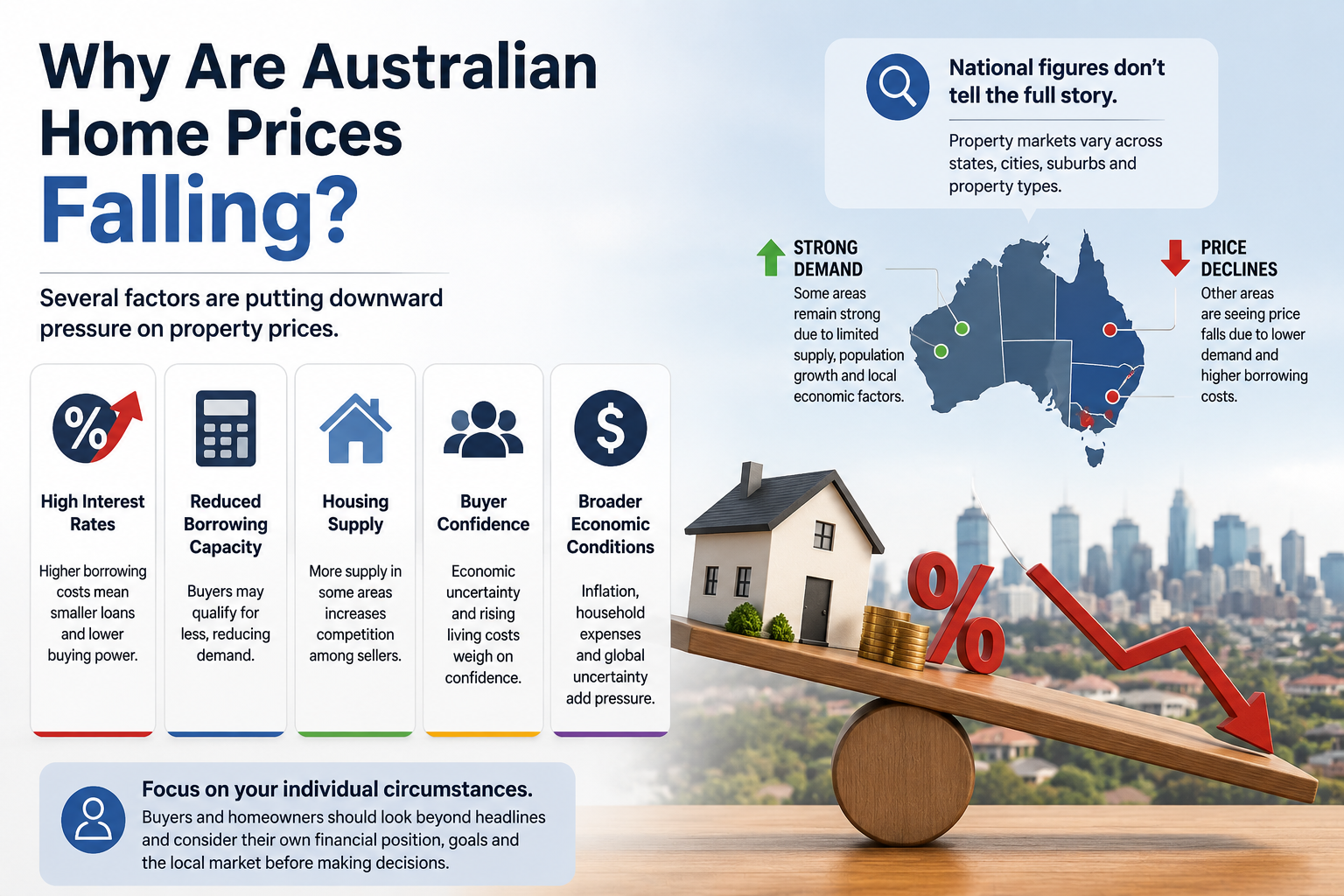
Property prices are influenced by several factors, including interest rates, borrowing capacity, housing supply, buyer confidence and broader economic conditions.
When borrowing costs remain high, buyers may qualify for smaller loans. This can reduce competition and place downward pressure on property prices. At the same time, uncertainty about future interest rates and household expenses may encourage some buyers to delay purchasing decisions.
However, national figures do not tell the full story.
Property markets can perform differently across states, cities, suburbs and property types. While prices may be declining in some areas, other locations may remain stable or continue to experience strong demand due to limited housing supply, population growth or local economic conditions.
That is why buyers and homeowners should consider their individual circumstances rather than making decisions based only on national headlines.
Could Falling Prices Create an Opportunity for Buyers?
For first-home buyers and property investors, a softer market may provide several potential advantages.
Lower prices may reduce the deposit required to purchase a property. Buyers may also face less competition, have more time to complete their research and gain greater negotiating power during the purchasing process.
A property that was previously outside your budget may become more achievable if prices continue to adjust.
However, a lower purchase price does not automatically mean a property is affordable.
Your borrowing capacity will still depend on factors such as:
Your income and employment position
Existing debts and financial commitments
Living expenses
Credit history
Available deposit
Interest rates and lender assessment requirements
It is also important to consider the total cost of ownership, including loan repayments, stamp duty, insurance, maintenance and other ongoing expenses.
Rather than trying to predict the exact bottom of the market, buyers may benefit from focusing on whether a property suits their budget, lifestyle and long-term financial goals.
What Could Falling Prices Mean for Homeowners?

For many homeowners, short-term price movements may have little impact if they plan to remain in their property for several years.
However, declining valuations may become more relevant when refinancing, accessing equity or applying for additional finance.
Your property’s value helps determine your loan-to-value ratio, commonly known as LVR. If the estimated value of your home falls while your loan balance remains relatively high, your LVR may increase.
This could affect:
Your ability to refinance with another lender
Access to certain interest rates or loan products
The amount of usable equity available
Your ability to borrow for renovations or investments
Whether lenders mortgage insurance may apply
For example, if your home was valued at $800,000 and your mortgage balance was $560,000, your LVR would be 70%.
If the property value declined to $700,000 while the loan remained at $560,000, the LVR would increase to 80%.
Although your loan balance has not changed, the lower valuation may affect the refinancing options available to you.
What Does This Mean for Property Investors?
Property investors may also need to review how changing valuations affect their overall lending position.
Lower property values may reduce usable equity, which is often used to help fund deposits for future investments. This may influence the timing or structure of a planned property purchase.
Investors should also consider rental income, cash flow, interest costs and long-term growth potential rather than focusing only on short-term price changes.
A softer market may create opportunities to negotiate, but every investment should still be assessed carefully based on the property, location, expected returns and the investor’s financial position.
Should You Refinance While Prices Are Falling?
Refinancing may still be worthwhile if you are looking for a more competitive interest rate, improved loan features, lower repayments or a loan structure that better suits your current needs.
However, your property’s updated valuation can play an important role in the outcome.
Before submitting multiple applications, it may be helpful to review:
Your estimated property value
Current loan balance
Available equity
Existing interest rate
Loan features and fees
Potential refinancing costs
Your current borrowing capacity
Understanding your position before applying may help you identify suitable options and avoid unnecessary applications.
Opportunity or Warning Sign?
Falling property prices are not automatically good or bad.
For some buyers, the changing market may create an opportunity to purchase with less competition or negotiate a better price. For some homeowners, lower valuations may affect refinancing or access to equity. For investors, the market may present new possibilities while also requiring more careful financial planning.
The right decision depends on your circumstances, financial position and long-term goals.
Before buying, refinancing or using property equity, consider reviewing your options with a mortgage professional. A clear understanding of your borrowing capacity, loan structure and potential repayments can help you make a more informed decision, regardless of where property prices move next.
General information only. This article does not constitute financial or credit advice. Your individual circumstances should be considered before making financial decisions.
